

Zanus AI Pricing Breakdown: Is This Private Enterprise AI Worth the Cost? (2027)
If you have been searching for Zanus AI pricing and hitting a wall — you are not alone.…
Read →Writing product descriptions is one of the most repetitive, time-consuming jobs in ecommerce. If you’re running a Shopify store with 50 products, that’s 50 descriptions to write, optimize, and keep updated. At 500 SKUs, it becomes a full-time job.
AI tools have changed this completely. The right tool can generate a conversion-ready, SEO-optimized product description in seconds — and do it consistently across your entire catalog.
But here’s the problem: most “best AI tools for ecommerce” articles lump product description generators in with customer support bots, inventory tools, and analytics platforms. That’s not useful if you just need to write better product copy faster.
This guide covers the 8 best AI tools specifically for ecommerce product descriptions in 2026, tested and matched by store size, budget, and use case. Every tool here is either listed in the HeloAITools directory or evaluated against the same criteria: output quality, brand voice control, Shopify compatibility, bulk generation capability, and value for money.
Product descriptions now do three jobs simultaneously:
A weak description costs you on all three fronts. AI tools that understand this — not just generic writing assistants — are the ones worth your time.
We assessed each tool on six criteria that actually matter for ecommerce:
| Criteria | Why It Matters |
|---|---|
| Output quality | Does the copy sound human and persuasive? |
| Brand voice control | Can you train it on your tone? |
| Bulk generation | Can it handle 100+ products at once? |
| Shopify/WooCommerce integration | Does it publish directly to your store? |
| SEO awareness | Does it optimize for keywords automatically? |
| Free plan / pricing | Is it accessible for small stores? |
| Tool | Best For | Free Plan? | Shopify Integration | Starting Price |
|---|---|---|---|---|
| Shopify Magic | Shopify stores, quick single descriptions | ✅ Included | ✅ Native | Free (with Shopify) |
| ChatGPT | Solo sellers, flexible prompting | ✅ Yes | ❌ Manual | 20/mo (Plus) |
| Rytr | Budget stores, short-form copy | ✅ Yes | ❌ Manual | 7.50/mo |
| Jasper | Brand-consistent copy at scale | ❌ Trial | ❌ Manual | $49/mo |
| Copy.ai | Marketing-focused descriptions | ✅ Limited | ❌ Manual | 49/mo |
| Writesonic | SEO-optimized descriptions | ✅ Limited | ❌ Manual | $20/mo |
| Describely | Bulk catalog generation | ❌ PAYG | ✅ Native | $0.75/product |
| Grammarly | Polishing & brand voice consistency | ✅ Yes | ❌ Browser ext. | 12/mo |
Best for: Shopify merchants who want zero-setup AI descriptions built into their admin
If you’re on Shopify, you already have access to Shopify Magic — and it’s genuinely good for single-product descriptions. Feed it a few keywords (product type, material, target audience, tone), and it generates a usable description in seconds. You can choose from tones like Professional, Playful, Persuasive, or Supportive.
What it does well:
Where it falls short:
Free plan: ✅ Included in all Shopify plans Paid: No additional cost
Verdict: The best starting point for any Shopify store. If you have under 30 products and don’t need strict brand consistency, Shopify Magic is all you need. For larger catalogs, you’ll quickly hit its ceiling.
Best for: Solo sellers and small stores who want full control over their copy
ChatGPT remains the most powerful and flexible AI writing tool available in 2026. With GPT-5.6 on the Plus tier, it produces product descriptions that are genuinely difficult to distinguish from professional copywriting — when you give it the right prompt.
The key insight from SERP research: the tool isn’t the bottleneck — the brief is. ChatGPT with a well-structured brand brief (tone, vocabulary, target buyer, structure rules) produces descriptions that outperform most paid specialist tools.
What it does well:
Where it falls short:
Sample prompt for product descriptions:
You are a copywriter for [Brand Name], a [brand description].
Our tone is [tone]. We never use words like [banned words].
Write a 150-word product description for: [product name]
Key features: [list features]
Target buyer: [describe buyer]
Include these keywords naturally: [keywords]
Free plan: ✅ Yes — GPT-4o with usage limits Paid: 25/user/month (Business)
Verdict: The best overall tool for stores that are willing to invest 30 minutes building a solid brand brief. The free tier handles up to ~10–15 descriptions per day comfortably.
Best for: Small stores and budget-conscious sellers who need fast short-form copy
Rytr is the most affordable AI writing tool that produces genuinely usable product descriptions. It has a dedicated “Product Description” use case template — you input the product name, key features, and tone, and it generates 2–3 variations instantly.
At $7.50/month for unlimited generations, it’s the lowest-cost paid option in this comparison by a significant margin.
What it does well:
Where it falls short:
Free plan: ✅ Yes — 10,000 characters/month Paid: 24.16/month (Premium with 5 brand voices)
Verdict: The best value tool for stores with under 100 products that need fast, affordable descriptions. Don’t use it for technical products with precise specs — always verify output. For a full review, see our Rytr listing →
Best for: Growing stores and marketing teams that need strict brand voice consistency
Jasper is the go-to AI writing platform for ecommerce brands that need to maintain a consistent voice across hundreds of product pages. Its Brand Voice feature trains on your existing copy and applies it automatically to every description generated — which is the key differentiator at scale.
For stores managing 200+ SKUs across multiple product categories, Jasper’s template library and brand controls make it significantly faster than prompting ChatGPT from scratch each time.
What it does well:
Where it falls short:
Free plan: ❌ Trial only Paid: From 69/month (Pro)
Verdict: Worth the price if you’re producing 50+ descriptions per month and need strict brand consistency across multiple writers. For solo sellers, ChatGPT + a good brief delivers similar quality at a fraction of the cost.
Best for: DTC brands that want descriptions optimized for conversion, not just information
Copy.ai is built around go-to-market content — and its product description templates reflect that. Rather than just listing features, Copy.ai’s output is structured around benefits, emotional triggers, and calls to action. For DTC brands selling lifestyle products (fashion, beauty, home goods), this conversion-first approach often outperforms more neutral tools.
What it does well:
Where it falls short:
Free plan: ✅ Limited — 2,000 words/month Paid: From $49/month (Pro, 5 users)
Verdict: Best for lifestyle and DTC brands where emotional copy drives conversions. The free plan is too limited for production use — treat it as a trial. For high-volume needs, the price-to-output ratio is weaker than Writesonic or Rytr.
Best for: Stores that want product descriptions to rank on Google
Writesonic stands out in this comparison for one specific reason: it integrates real-time SEO data into the writing process. Its AI Article Writer 6.0 performs SERP analysis, integrates keyword data, and fact-checks output — features that most pure writing tools don’t offer.
For ecommerce stores that rely on organic search traffic, this makes Writesonic the strongest choice for descriptions that need to rank, not just convert.
What it does well:
Where it falls short:
Free plan: ✅ Limited — 25 credits Paid: From 79/month (Standard)
Verdict: The best choice for stores where SEO is the primary traffic driver. If you’re investing in organic search, Writesonic’s built-in keyword optimization pays for itself quickly.
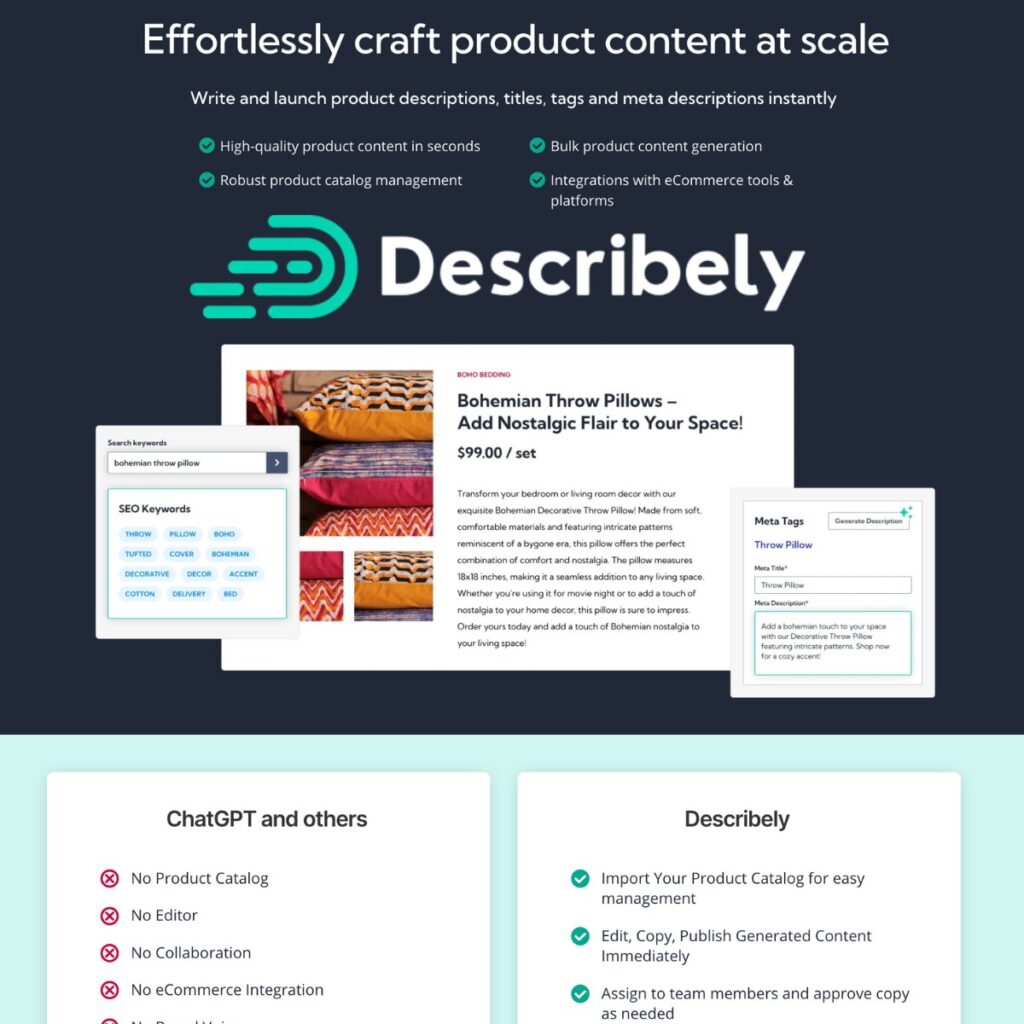
Best for: Stores with 100+ SKUs that need to generate descriptions at catalog scale
Describely (part of the Copysmith ecosystem) is the only tool in this comparison purpose-built for catalog-scale product description generation. It connects directly to Shopify, imports your entire catalog, generates descriptions in bulk with brand rules applied consistently, and publishes back to your store in one click.
For stores with large catalogs — or agencies managing multiple brands — this workflow is fundamentally different from any other tool here.
What it does well:
Where it falls short:
Free plan: ❌ Pay-as-you-go only Paid: 0.55/enrichment credit — no subscription required
Verdict: The only tool that solves the catalog-scale problem properly. If you have 100+ SKUs and need consistent, on-brand descriptions across all of them, Describely is the right choice. For a full breakdown, see our Copysmith/Describely listing →
Best for: Stores that generate descriptions with other tools and need a final quality pass
Grammarly isn’t a product description generator — it’s the tool you use after generating. In 2026, Grammarly’s AI goes far beyond grammar checking: it adjusts tone, rewrites sentences for clarity, checks for brand voice consistency, and flags copy that sounds robotic or generic.
For ecommerce teams using multiple writers or AI tools, Grammarly acts as the quality gate before descriptions go live.
What it does well:
Where it falls short:
Free plan: ✅ Yes — basic grammar and tone Paid: From 15/user/month (Business)
Verdict: Non-negotiable for any store publishing AI-generated descriptions at scale. The browser extension installs in 30 seconds and works directly inside Shopify admin. Use it as the final step before publishing.
Not every store needs the same tool. Here’s a decision framework based on store size and priority:
Use: Shopify Magic (free) + Grammarly (free) Monthly cost: $0 Why: Zero setup, zero cost. Shopify Magic generates the description; Grammarly polishes it. Good enough for most new stores.
Use: ChatGPT Plus + Grammarly Monthly cost: ~$32/month Why: ChatGPT with a solid brand brief produces the best quality-to-cost ratio at this scale. Grammarly ensures consistency.
Use: Rytr (Unlimited) + Grammarly (free) Monthly cost: ~7.50/month is the lowest-cost option for unlimited descriptions. Quality is lower than ChatGPT but sufficient for most product categories.
Use: Writesonic + Surfer SEO Monthly cost: ~$120/month Why: Writesonic’s built-in SEO optimization + Surfer SEO’s content scoring gives you descriptions that rank and convert.
Use: Describely Monthly cost: Pay-as-you-go (~150 for 100–200 products) Why: The only tool that handles true catalog-scale generation with Shopify sync and brand rules. One-time cost per product, not a recurring subscription.
Use: Jasper + Grammarly Monthly cost: ~$61/month Why: Jasper’s Brand Voice training ensures every description sounds like your brand, even across multiple writers.
1. Generating from product name alone Any tool that writes a description from just a product name will hallucinate specifications. Always provide complete product data: dimensions, materials, compatibility, key features.
2. Publishing without a human review AI descriptions can be fluent but factually wrong. Always verify specs before publishing — a wrong dimension or material claim creates returns and brand damage.
3. Using the same description across platforms Amazon, Shopify, and Google Shopping have different character limits, formatting rules, and keyword priorities. Customize descriptions for each platform.
4. Ignoring SEO keywords A great-sounding description that doesn’t include your target keywords won’t rank. Use Writesonic or Surfer SEO to ensure keyword integration.
5. Skipping the brand brief The single biggest reason AI descriptions sound generic is a missing brand brief. Spend 30 minutes writing a 200-word brief covering your tone, vocabulary, banned words, and target buyer — then use it in every prompt.
For Shopify stores just starting out, Shopify Magic (free, built-in) is the best starting point. For quality and flexibility, ChatGPT Plus with a solid brand brief produces the best output at $20/month. For large catalogs (100+ SKUs), Describely is the only tool built for true bulk generation with Shopify sync.
Yes — but only if the tool integrates keyword data into the generation process. Writesonic is the strongest option for SEO-optimized descriptions, with built-in keyword research and SERP analysis. ChatGPT can also produce SEO-friendly descriptions if you include target keywords in your prompt.
Yes. Shopify Magic is completely free for all Shopify merchants. ChatGPT’s free tier (GPT-4o) handles ~10–15 descriptions per day. Rytr’s free plan covers 10,000 characters/month (roughly 50–60 short descriptions). Grammarly’s free tier polishes any AI-generated copy.
The solution is a brand brief — a 200–300 word document that defines your tone, vocabulary, banned words, target buyer, and structural rules. Feed this brief into every prompt. Without it, any AI tool defaults to generic commercial copy. With it, output quality improves dramatically regardless of which tool you use.
Yes — but only Describely offers true catalog-scale bulk generation with native Shopify integration. Shopify Magic generates one product at a time. ChatGPT, Jasper, Rytr, and Copy.ai all require manual copy-paste into Shopify admin.
General AI writing tools (ChatGPT, Jasper, Rytr, Copy.ai) are built for all content types — blogs, emails, ads, and product descriptions. Specialist product description generators (Describely, Shopify Magic) are built specifically for ecommerce catalog workflows: bulk import, brand rules, and direct store publishing. For stores under 100 products, general tools are sufficient. For larger catalogs, specialist tools save significant time.
The best AI tool for ecommerce product descriptions depends entirely on your store size and priority:
Start with the free tier of whichever tool matches your store size. Build a brand brief before you generate a single description. And always review AI output before publishing — the tool handles the speed, you handle the accuracy.
Explore all tools mentioned in this article in the HeloAITools ecommerce directory →

If you have been searching for Zanus AI pricing and hitting a wall — you are not alone.…
Read →Searching “free AI video generator no watermark no sign up” usually turns up a wall of listicles promising…
Read →Three tools. Three completely different answers to the same question. The question is: what does “best AI video…
Read →