Trusted GPT-5, ChatGPT, and AI detector tool — with real accuracy limits worth knowing
Last updated August 29, 2026
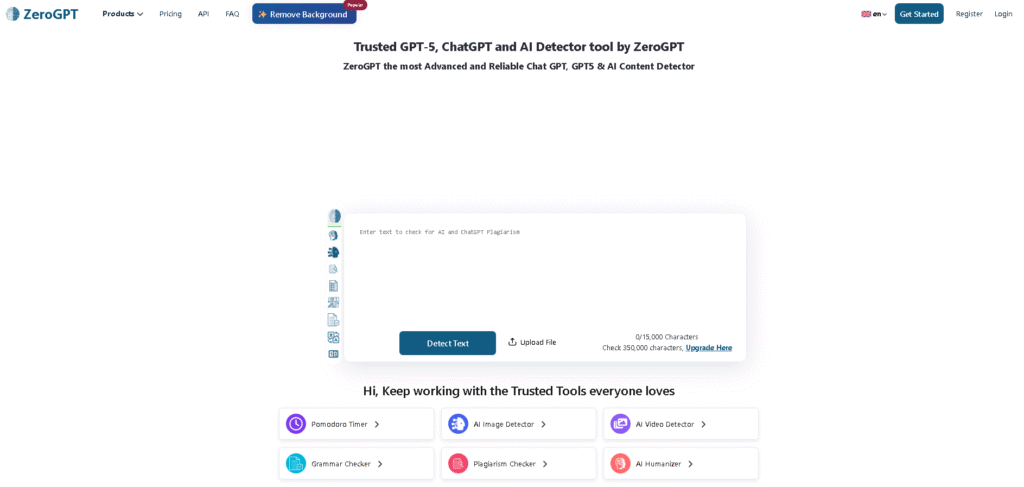
ZeroGPT is an AI content detector built to identify text generated by ChatGPT, GPT-5, Gemini, Grok, DeepSeek, Claude, and other large language models, alongside a broader suite of writing tools — plagiarism checking, paraphrasing, summarizing, grammar checking, translation, and an AI humanizer. It analyzes submitted text through what it calls DeepAnalyse™ Technology, a multi-stage methodology the company says is trained on extensive internet text, educational datasets, and proprietary synthetic AI datasets across multiple model families.
Independent 2026 benchmarking paints a more mixed picture than ZeroGPT’s own marketing suggests. Overall accuracy has been measured around 74% in controlled testing, but the more consequential number is the false positive rate — how often genuinely human-written text gets incorrectly flagged as AI-generated. Multiple independent studies report this ranging from roughly 7% up to over 30% depending on content type, with technical writing, academic prose, and non-native English speakers’ writing all disproportionately affected. Detection accuracy also drops sharply against paraphrased or “humanized” AI text — in some tests, basic paraphrasing cut GPT-5 detection down to around 22%.
ZeroGPT also offers a broader writing toolkit beyond detection — grammar checking, an AI humanizer, plagiarism checking, summarizing, and translation — plus integrations via WhatsApp and Telegram bots, and a developer API covering detection, plagiarism, paraphrasing, and more.
Who should think twice: educators, HR teams, or anyone making high-stakes decisions (grading, hiring, academic integrity cases) based on a single detection result — see the accuracy caveats below before treating any AI detector’s output as definitive proof.
Pros
Cons
If you’re comparing ZeroGPT against other AI detection tools:
Browse more in AI Detection tools →
How does ZeroGPT AI Detector work?
ZeroGPT analyzes submitted text using its DeepAnalyse™ methodology, a multi-stage approach trained on internet text, educational datasets, and proprietary AI-generated datasets, to estimate the likelihood specific sentences were AI-generated.
What is the accuracy rate of ZeroGPT?
ZeroGPT does not claim 100% accuracy, and independent 2026 testing measured overall accuracy around 74% in controlled benchmarks — but treat any single detection result as an indicator, not proof, given the false-positive concerns below.
How often does ZeroGPT flag human writing as AI-generated?
Independent studies report false-positive rates ranging from roughly 7% to over 30% depending on content type, with academic and technical writing, and non-native English speakers’ writing, disproportionately affected. This is the single most important limitation to understand before relying on a ZeroGPT result for any consequential decision.
Who benefits from ZeroGPT’s AI content detector?
Content teams doing a low-stakes first-pass check on drafts, and individuals wanting to understand how their own writing style reads to a detector, benefit most. High-stakes use cases (grading, hiring) carry real risk given the false-positive rate.
Will my text get plagiarized or be available online if I check it on ZeroGPT?
Review ZeroGPT’s current privacy policy directly before submitting sensitive or unpublished content to any third-party detection tool — this wasn’t independently verifiable in the material reviewed for this listing.
Does ZeroGPT work with different languages?
Yes. ZeroGPT has multilingual usage and detects AI-generated text across the languages it supports.
How can I cite the AI detector?
If citing a ZeroGPT result in academic or professional work, disclose the tool’s known false-positive limitations alongside the result itself, rather than presenting a detection score as conclusive evidence on its own.
| Criteria | Rating |
|---|---|
| Accuracy & Reliability | ⭐ 3.2/5 |
| Ease of Use | ⭐ 4.5/5 |
| Features & Functionality | ⭐ 4.3/5 |
| Performance | ⭐ 4.0/5 |
| Customization | ⭐ 3.8/5 |
| Security & Privacy | ⭐ 3.6/5 |
| Customer Support | ⭐ 3.7/5 |
| Value for Money | ⭐ 4.1/5 |
| Integrations | ⭐ 4.2/5 |
Koala AI is an AI growth platform built for content creators, bloggers, niche site owners, and SEO professionals who…

DeepL Write is an AI-powered writing assistant from DeepL, the company best known for its AI translation engine.…

ChatGPT, built by OpenAI, remains the most widely used AI assistant in the world — the default most…
Grammarly is an AI-powered writing assistant that helps you write clearer, more polished, and mistake-free text across email,…

Jasper AI is a marketing-focused AI platform built to run end-to-end marketing workflows through purpose-built AI agents —…

DeepSeek is an advanced AI platform developed by DeepSeek AI, offering powerful large language models (LLMs) for chat,…

Bing AI, now integrated into Microsoft Copilot, is an AI-powered assistant that combines web search, content generation, coding…

Perplexity AI is an intelligent AI search and research platform designed to replace traditional search engines with conversational,…

SellyAI is an AI-powered product listing generator that turns a photo, a product URL, or a few typed words…

Claude AI is a next-generation conversational AI assistant created by Anthropic. Built to help individuals, teams, and businesses,…

Winston AI is a powerful AI detection platform that helps educators, writers, businesses, and publishers identify AI-generated content…
Yomu AI is an AI-powered academic writing and research assistant designed to help students, researchers, academics, and other…