
Zanus AI Pricing Breakdown: Is This Private Enterprise AI Worth the Cost? (2027)
If you have been searching for Zanus AI pricing and hitting a wall — you are not alone.…
Read →AI agents have moved from buzzword to business infrastructure in 2026. Microsoft Agent 365 hit general availability in May, ChatGPT Work launched in July, and Claude Cowork followed days later — all billing by consumption, all designed to act autonomously on your behalf.
But “AI agent” now covers everything from a no-code workflow builder to a fully autonomous research assistant that browses the web, writes code, and delivers finished reports while you sleep. Picking the wrong one wastes money and time.
This guide cuts through the noise. We tested and ranked the 10 best AI agent tools in 2026 across five categories — so whether you’re a solo creator, a technical team, or an enterprise, you’ll find the right fit.
An AI agent tool is software that can plan, decide, and act on multi-step tasks without requiring a human to direct every step. Unlike a chatbot that answers questions, an agent:
The best AI agent tools in 2026 combine a large language model (like GPT-5.6, Claude Opus 5, or Gemini) with real-world integrations and the ability to take action — not just generate text.
We evaluated each tool on:
| Tool | Best For | Starting Price | Skill Level |
|---|---|---|---|
| n8n | Technical teams, self-hosting | €24/mo | Intermediate–Advanced |
| Manus AI | Autonomous deep research | $20/mo | Beginner–Intermediate |
| Zapier Agents | Business owners, large app library | $50/mo (Agents add-on) | Beginner |
| Taskade | All-in-one productivity + agents | $6/mo | Beginner |
| Chatbase | Customer support AI agents | Free | Beginner |
| LivePerson | Enterprise CX orchestration | Custom | Advanced |
| Optimizely | Marketing & experimentation agents | Custom | Intermediate |
| AIAgentSkills | Developers building Claude agents | Free | Advanced |
| Perplexity | Research & agentic browsing | Free | Beginner |
| Manus AI | Full-stack app building from prompt | Custom | Intermediate |
n8n is the power user’s choice for building AI agents in 2026. It’s a visual, node-based workflow automation platform that lets you connect 500+ integrations, write custom JavaScript or Python inline, and — crucially — self-host your entire deployment for complete data control.
Unlike most agent platforms that lock you into their cloud, n8n gives you full visibility into every step of an agent’s reasoning. You can intervene with rule-based logic, mock external systems for debugging, and re-run individual steps without restarting the whole workflow.
Trusted by teams at Microsoft, Meta, NVIDIA, and Vodafone, n8n has become the go-to for IT Ops, SecOps, DevOps, and sales teams that need automation they can fully inspect — not a black box.
What makes it stand out in 2026:
Pricing:
Best for: Technical teams, IT/DevOps, security-conscious organizations, developers building multi-agent systems.
Not ideal for: Non-technical users or solo operators who want a quick setup without learning JSON and APIs.
Manus AI is the closest thing to a digital employee in 2026. You give it a goal — not a prompt — and it plans the steps, browses the web, writes and runs code, and delivers finished work without needing instructions at every stage.
In real-world testing, Manus was asked to run a competitive analysis on project management software: scrape pricing tiers, cross-reference multiple sources, and compile findings into a downloadable Excel sheet. It opened multiple browser tabs, navigated the web, handled data extraction, and delivered the finished file in 15 minutes — with no human intervention.
Since its 2025–2026 updates, Manus can also build complete web applications (backend, database, and authentication included) from a single natural-language prompt — a genuine differentiator versus tools that only generate front-end code.
What makes it stand out in 2026:
Pricing:
Best for: Content strategists, researchers, marketers, and founders who need deep autonomous research, competitive analysis, or rapid app prototyping.
Watch out for: Credit consumption is unpredictable on complex tasks. Treat early outputs as drafts — the agent makes judgment calls you don’t see until the end.
👉 Read our full Manus AI review →
Zapier is the OG of automation, and in 2026 it’s evolved into a genuine AI agent platform — though its DNA is still rooted in workflow automation rather than pure agentic AI.
The Zapier Agent Builder lets you create flexible automations with natural-language instructions, so agents aren’t bound to rigid “if this, then that” logic. With 8,000+ integrations, if you’re already using a tool, Zapier almost certainly connects to it.
The key advantage: stability and ecosystem. Zapier has been battle-tested for over a decade. There are thousands of tutorials, templates, and community resources. For business owners who want AI layered on top of a proven platform — without rebuilding their entire stack — Zapier is the pragmatic choice.
What makes it stand out in 2026:
Pricing:
Best for: Business owners, marketers, and operations teams already using many SaaS tools who want AI without rebuilding their stack.
Not ideal for: Teams that need true agentic AI from the ground up — the AI features can feel bolted on rather than native.
👉 Read our full Zapier review →
Taskade takes a different approach: instead of a standalone agent builder, it embeds AI agents directly into a productivity workspace. One prompt can generate a fully functional app, a project plan, a set of AI agents, and the automations to run them — all inside a single interface.
For teams that want to stop juggling five different tools (project management, docs, chat, automation, AI), Taskade is the most integrated option on this list. It’s also the most affordable entry point for teams wanting agents without a steep learning curve.
What makes it stand out in 2026:
Pricing:
Best for: Small teams and startups that want AI agents embedded in their daily workflow without managing a separate automation platform.
👉 Read our full Taskade review →
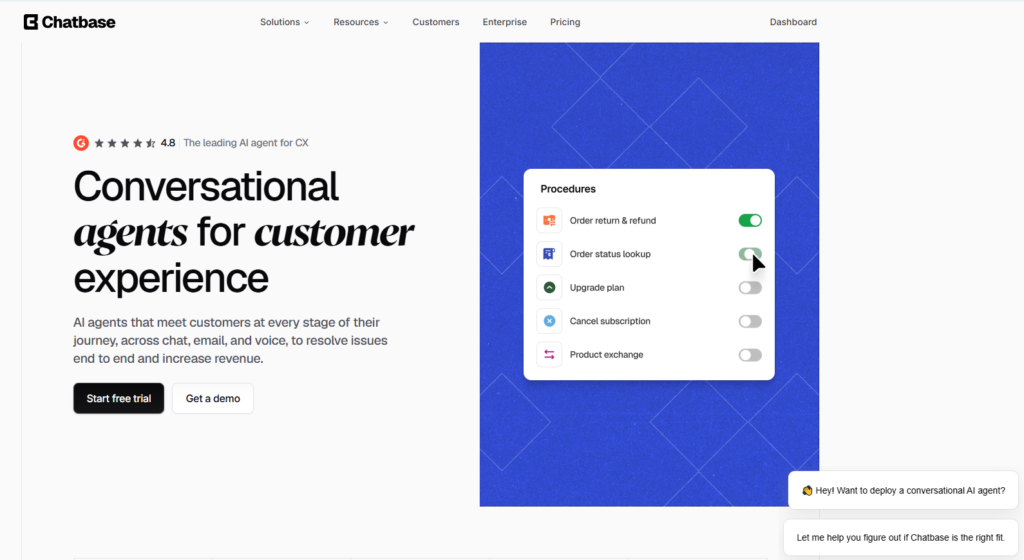
Chatbase is the go-to platform for businesses that want to deploy AI agents for customer support, lead generation, and sales — without writing a single line of code.
You connect your data sources (website, docs, PDFs, Notion, Google Drive), and Chatbase builds an AI agent that can answer customer questions, qualify leads, book appointments, and escalate to humans when needed. It integrates with WhatsApp, Slack, Messenger, and your website via embed.
In 2026, Chatbase has expanded its agent capabilities significantly — agents can now take actions (not just answer questions), integrate with CRMs, and handle multi-turn conversations with memory.
What makes it stand out in 2026:
Pricing:
Best for: E-commerce stores, SaaS companies, and service businesses that want 24/7 AI customer support without a developer.
👉 Read our full Chatbase review →
LivePerson is built for large-scale customer experience operations where you need to orchestrate both human agents and AI agents across messaging, voice, and digital channels — at enterprise scale.
Unlike simpler chatbot tools, LivePerson’s Conversational Cloud uses AI to route conversations intelligently, predict customer intent, and hand off between AI and human agents seamlessly. It’s used by major brands in retail, financial services, and telecoms to handle millions of conversations per month.
What makes it stand out in 2026:
Pricing: Custom (contact sales)
Best for: Enterprise companies in retail, finance, and telecoms managing high-volume customer interactions across multiple channels.
👉 Read our full LivePerson review →
Optimizely uses AI agents to automate marketing operations — from content creation and A/B testing to personalization and campaign optimization — without continually adding headcount.
Its AI agents can identify bottlenecks in marketing workflows, suggest and run experiments, and personalize digital experiences at scale. For marketing teams drowning in manual optimization tasks, Optimizely’s agentic layer is a genuine force multiplier.
What makes it stand out in 2026:
Pricing: Custom (contact sales)
Best for: Enterprise marketing teams that want AI to automate experimentation, personalization, and content operations.
👉 Read our full Optimizely review →
AIAgentSkills is a community-run index of reusable “AI Agent Skills” — capability packages (also known as Claude MCP skills) that developers can plug into their agent builds without starting from scratch.
Think of it as an open-source library of pre-built agent capabilities: web search, data extraction, code execution, API calls, and more. For developers building on Claude or other LLMs, it dramatically reduces the time to build production-ready agents.
What makes it stand out in 2026:
Pricing: Free
Best for: Developers and technical teams building custom AI agents on Claude or other LLMs who want a head start with pre-built capabilities.
👉 Read our full AIAgentSkills review →
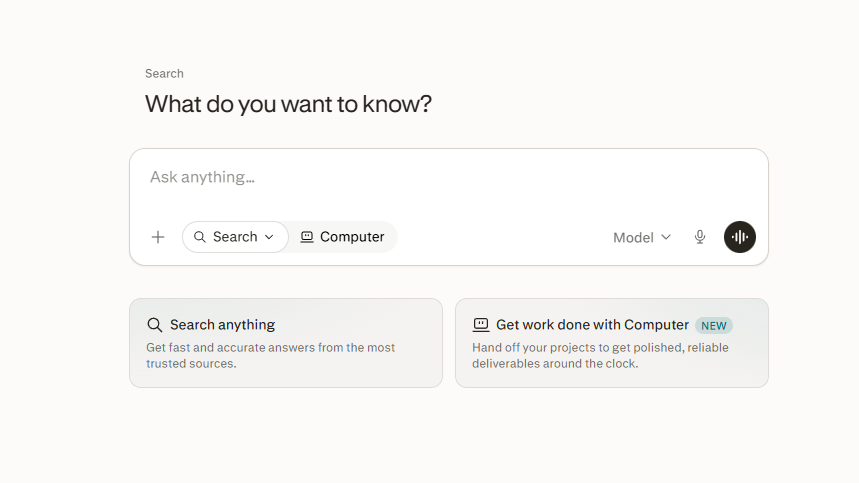
Perplexity has evolved from an AI search engine into a genuine research agent in 2026. Its Deep Research feature routes subtasks across 20+ models, browses the live web, synthesizes sources, and delivers structured, cited reports — all from a single query.
For researchers, analysts, and content creators who need fast, reliable, cited research without building a custom agent, Perplexity is the lowest-friction option on this list. No setup, no API keys, no workflow building — just ask and get a researched answer.
What makes it stand out in 2026:
Pricing:
Best for: Researchers, analysts, journalists, and content creators who need fast, cited research without building a custom agent workflow.
👉 Read our full Perplexity review →
For teams that have outgrown single-tool solutions, the Chatbase + n8n combination represents the most powerful and cost-effective full-stack agent setup in 2026:
Together, they cover the full agent lifecycle — from customer interaction to back-end automation — at a fraction of the cost of enterprise platforms like LivePerson or Optimizely.
Best for: Growing SaaS companies, agencies, and e-commerce businesses that want enterprise-grade agent capabilities without enterprise pricing.
You’re non-technical and want quick results → Start with Taskade or Chatbase. Both have free plans and deploy in minutes.
You want autonomous research done for you → Manus AI or Perplexity Deep Research. Manus for complex, long-horizon tasks; Perplexity for fast, cited answers.
You’re technical and want full control → n8n is the clear winner. Self-host it, connect anything, write custom code where needed.
You already use 50+ SaaS tools → Zapier Agents leverages your existing stack without rebuilding anything.
You’re an enterprise with high-volume CX needs → LivePerson for customer experience, Optimizely for marketing operations.
You’re a developer building custom agents → AIAgentSkills for pre-built MCP skills, n8n for orchestration.
The biggest shift in Q3 2026 is consumption-based pricing replacing seat-based pricing. Microsoft Agent 365, ChatGPT Work, and Claude Cowork all bill by usage — meaning seat-based forecasting no longer describes what these products cost. Budget accordingly.
The second shift: model routing is replacing model picking. There’s no longer a clean ladder you can read off a price list. The winning pattern is routing per task — using the right model for each sub-task rather than standardizing on one frontier model for everything. Tools like n8n and Perplexity already do this natively.
What is the best AI agent tool in 2026?
It depends on your use case. For technical teams, n8n is the top pick. For autonomous research, Manus AI leads. For no-code customer support agents, Chatbase is the easiest to deploy. For business owners with large app stacks, Zapier Agents is the most practical.
Are AI agent tools free? S
everal tools on this list have free plans: n8n (Community Edition, self-hosted), Chatbase (free tier), Taskade (free tier), Perplexity (free tier), and AIAgentSkills (completely free). Paid plans unlock more executions, integrations, and advanced agent capabilities.
What’s the difference between an AI agent and a chatbot?
A chatbot responds to questions. An AI agent plans, decides, and acts — it can browse the web, write and run code, update databases, send emails, and complete multi-step tasks without human direction at every step.
Can AI agents replace employees?
Not entirely, but they can automate significant portions of repetitive, multi-step work. In 2026, the most effective teams use AI agents to handle research, data processing, customer support triage, and workflow automation — freeing humans for judgment-heavy work.
Which AI agent tool is best for small businesses?
Taskade ($6/mo) and Chatbase (free) are the most accessible for small businesses. Both require no technical background and deploy quickly.
The best AI agent tool in 2026 isn’t one tool — it’s the right tool for your specific use case, skill level, and budget.
Browse all AI Agent tools on HeloAITools → to compare ratings, pricing, and alternatives side by side.

If you have been searching for Zanus AI pricing and hitting a wall — you are not alone.…
Read →Searching “free AI video generator no watermark no sign up” usually turns up a wall of listicles promising…
Read →Three tools. Three completely different answers to the same question. The question is: what does “best AI video…
Read →