The quality layer your AI coding agents are missing
Last updated August 31, 2026
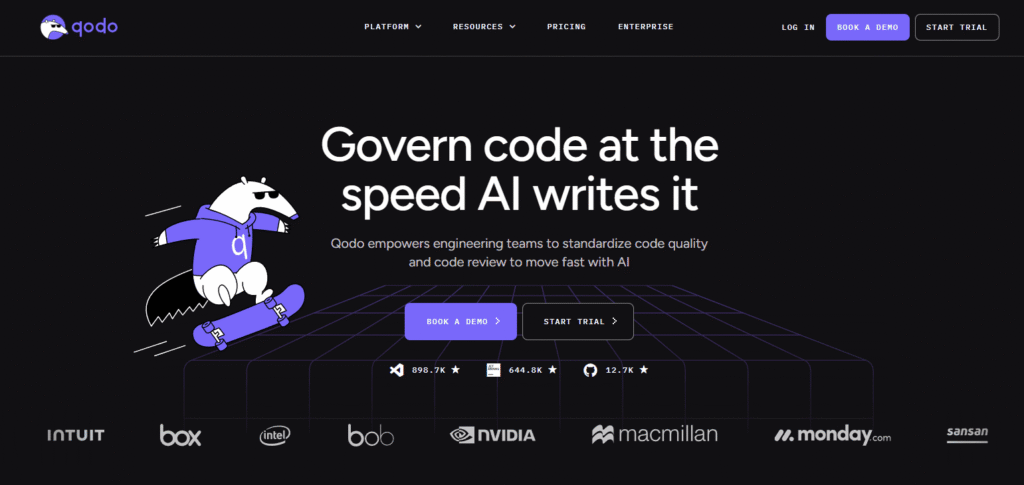
Qodo is an AI code review and governance platform built for engineering teams shipping software at the speed AI writes it. Where most AI coding tools focus on writing code faster, Qodo focuses on the other half of the problem — making sure that code is actually correct, consistent, and safe before it reaches production.
Trusted by engineering teams at NVIDIA, Walmart, Intuit, Monday.com, Intel, Macmillan, and Pax8, Qodo runs specialized review agents on every pull request, surfacing real bugs, rule violations, logic gaps, and requirement mismatches with full cross-repo codebase context — not just the diff in front of it.
The core insight behind Qodo is that code review is breaking down as AI writes more code. Coding agents generate and refactor faster than humans can review, while standards still live in wikis and senior engineers’ heads. Qodo solves this with a three-layer approach: agentic PR review that catches real issues before merge, a self-learning Rules System that turns tribal knowledge into machine-enforceable standards, and a governance layer that gives engineering leaders full visibility into code quality, risk concentration, and resolution rates across every repo and team.
Qodo works across your entire SDLC — inside the IDE for real-time validation while you code, on every pull request in GitHub, GitLab, Bitbucket, and Azure DevOps, and via CLI for local review workflows. The same context engine, the same rules, and the same review agents run on every surface.
14-day free trial. No credit card required.
Pros
Cons
Engineering teams adopting AI coding tools — If your team is using Cursor, Devin, GitHub Copilot, or other AI coding agents, Qodo provides the governance layer that keeps AI-generated code consistent with your standards before it reaches production.
Platform and DevOps teams — Qodo’s governance analytics dashboard, audit trail, and repo relationship mapping give platform teams the visibility they need to manage code quality across hundreds of repos and teams at scale.
Engineering leaders and CTOs — The governance layer provides a system of record for code quality decisions, risk concentration tracking, and resolution rate analytics — the data needed to make informed decisions about engineering velocity vs. quality tradeoffs.
Enterprise engineering organizations — NVIDIA (highlighted in Qodo’s case study), Walmart, Intuit, and Monday.com use Qodo to maintain consistent standards across large, distributed engineering organizations where manual code review can’t scale.
Teams with legacy or complex codebases — Qodo’s cross-repo context and repo relationship mapping are particularly valuable for organizations with interconnected microservices, shared SDKs, or legacy systems where a change in one repo can break downstream consumers.
Teams onboarding new developers — The Rules System and shift-left review skills help new developers learn your team’s standards faster by surfacing violations in real time inside their IDE before code is even committed.
Uncommon use cases: Using Qodo’s Rules System to operationalize security compliance requirements (GDPR, HIPAA) as enforceable code standards; using the audit trail for regulatory compliance reporting; using cross-repo review to manage breaking changes in public APIs.
| Feature | Qodo | GitHub Copilot | Cursor (Bugbot) |
|---|---|---|---|
| Primary focus | AI code review + governance platform | AI code completion + chat | AI coding agent + PR review |
| Agentic PR review | ✅ Yes — specialized agents per PR | ✅ Yes — Copilot PR review | ✅ Yes — Bugbot |
| Cross-repo context | ✅ Yes — full cross-repo reasoning | ❌ No | ❌ No |
| Self-learning rules | ✅ Yes — mined from PR history | ❌ No | ❌ No |
| Governance dashboard | ✅ Yes — risk, resolution rates, findings | ❌ No | ❌ No |
| Repo relationship mapping | ✅ Yes — visual dependency map | ❌ No | ❌ No |
| Audit trail | ✅ Yes — full compliance logging | ❌ No | ❌ No |
| Shift-left IDE review | ✅ Yes — real-time in IDE | ✅ Yes — inline suggestions | ✅ Yes — inline edits |
| AI-generated code review | ✅ Yes — specialized detection | ⚠️ Limited | ⚠️ Limited |
| Zero data retention | ✅ Yes — code analyzed and discarded | ⚠️ Privacy mode available | ✅ Yes — privacy mode |
| SOC 2 Type II | ✅ Yes — independently audited | ✅ Yes | ✅ Yes |
| On-prem deployment | ✅ Yes (Enterprise) | ✅ Yes (Enterprise) | ❌ No |
| BYOK | ✅ Yes (Enterprise) | ❌ No | ❌ No |
| Free trial | ✅ 14 days, no card | ✅ Free plan | ✅ Free plan |
| Paid from | $30/mo (Pro Team) | $10/user/mo | $20/mo (Pro) |
| Best for | Code review governance at scale | Code completion + basic review | Agentic development + PR review |
Choose Qodo if: Your team needs a dedicated code review and governance platform — especially for managing AI-generated code quality, enforcing standards across multiple repos, and giving engineering leaders visibility into code quality metrics. Qodo is the strongest tool specifically for the governance layer of AI-assisted development.
Choose Cursor if: You want the most capable AI coding agent with autonomous Cloud Agents, multi-model support, and a strong desktop IDE experience. Cursor’s Bugbot handles PR review but without Qodo’s cross-repo context, self-learning rules, or governance analytics.
Choose GitHub Copilot if: You want the lowest-cost entry point ($10/user/month) for AI code completion and basic PR review inside your existing GitHub workflow, without the complexity of a dedicated governance platform.
Step 1: Start your free trial
Step 2: Install on your repositories
Step 3: Install the IDE extension (optional but recommended)
Step 4: Let the Rules System learn your codebase
Step 5: Set up governance visibility
Step 6: Choose your paid plan after trial
| Plan | Price | Best For |
|---|---|---|
| Free Trial | $0 for 14 days | Full platform access, unlimited reviews and credits, no credit card required |
| Pro Team | $30/mo base + credit packs | Teams up to 30 users — agentic PR review, rules system, Git + IDE integrations, dashboard analytics |
| Enterprise | Custom | 30+ users — SSO/SAML, BYOK, single-tenant SaaS or on-prem, advanced analytics, dedicated CSM |
Credit Pack Options (Pro Team):
| Credits | Reviews/Month | Price |
|---|---|---|
| 2,500 credits | ~18 reviews/mo | Included in base |
| 5,000 credits | ~36 reviews/mo | Additional cost |
| 20,000 credits | ~144 reviews/mo | Additional cost |
How credits work: $0.012 per credit, pooled across the team. Smaller PRs use fewer credits; larger or more complex reviews use more. Your dashboard shows real-time balance and burn rate. Switch credit packs anytime. No annual commitment on Pro Team. Overage continues at the same per-credit rate with a monthly cap you set and control.
Is there a free plan? No permanent free plan — Qodo offers a 14-day free trial with unlimited reviews and credits. Open source projects can apply for free access via the Qodo for Open Source program.
Enterprise adds: SSO/SAML, audit logs, advanced self-learning, BYOK (bring your own LLM keys), single-tenant SaaS or on-prem deployment, priority support with SLA, dedicated CSM, annual contracts, and MSA/DPA.
Verdict: Yes — the strongest dedicated AI code review and governance platform available, especially for teams shipping AI-generated code at scale.
Qodo fills a gap that most AI coding tools leave open: the governance layer. As teams adopt Cursor, Devin, and other AI coding agents, the volume of code being generated outpaces what human reviewers can handle. Qodo’s specialized review agents, self-learning rules system, and cross-repo context provide the quality infrastructure that keeps standards consistent as AI-assisted development scales.
The zero data retention policy, SOC 2 Type II certification, and on-prem deployment option make it one of the few AI code review tools genuinely viable for regulated industries and security-conscious enterprises.
Best for: Engineering teams of 5–500+ developers who are actively using AI coding tools and need a dedicated governance layer to maintain code quality, enforce standards, and give engineering leaders visibility into what’s actually shipping.
Skip it if: You’re a solo developer or very small team who primarily needs code completion assistance — Cursor or GitHub Copilot cover that use case at lower cost without the governance complexity.
If Qodo isn’t the right fit for your team’s budget, workflow, or use case, here are the closest alternatives worth evaluating:
1. Cursor The most widely used AI coding agent in 2026, with Bugbot for automated PR reviews. Cursor’s Bugbot handles basic agentic code review but without Qodo’s cross-repo context, self-learning rules system, or governance analytics dashboard. Best choice if you want a full AI coding agent (write + review) in one tool rather than a dedicated review governance platform.
2. Devin The world’s first autonomous AI software engineer — handles full engineering tasks including PR review and visual QA. Devin’s review capabilities are part of a broader autonomous engineering platform rather than a dedicated governance layer. Best choice if you need an AI that writes and reviews code autonomously, rather than a platform focused purely on code quality governance.
3. SE Ranking Not a coding tool, but relevant for engineering teams at SaaS companies that also need AI visibility tracking alongside their development workflow. SE Ranking tracks how your product appears in AI search results — a complementary tool for product-led engineering teams.
4. Writesonic Relevant for engineering teams at product companies that need AI search visibility (GEO) tracking alongside their development work. Writesonic’s Action Center prioritizes fixes to how your brand appears in ChatGPT and Gemini — a complementary tool for teams building consumer-facing products.
5. Copy.ai Not a coding tool, but relevant for engineering teams that also need AI-powered GTM workflows — connecting engineering output to marketing and sales automation. Best choice if your team needs AI across both engineering and go-to-market operations.
Browse more tools in AI Tools For Coding → and AI Agents →
| Criteria | Rating |
|---|---|
| Accuracy & Reliability | ⭐ 4.9/5 |
| Ease of Use | ⭐ 4.5/5 |
| Features & Functionality | ⭐ 5.0/5 |
| Performance & Speed | ⭐ 4.8/5 |
| Customization | ⭐ 4.9/5 |
| Security & Privacy | ⭐ 5.0/5 |
| Customer Support | ⭐ 4.6/5 |
| Value for Money | ⭐ 4.5/5 |
| Integrations | ⭐ 4.9/5 |
What is Qodo?
Qodo is an AI code review and governance platform for engineering teams shipping at the speed AI writes code. It reviews every pull request with full cross-repo codebase context, enforces coding standards through a self-learning rules system, and provides governance visibility across every repo and team.
Is Qodo free?
Qodo offers a 14-day free trial with unlimited reviews and credits — no credit card required. There is no permanent free plan after the trial. Open source projects can apply for free access via the Qodo for Open Source program.
How much does Qodo cost?
Qodo’s Pro Team plan starts at 0.012 per credit pooled across the team. Credit packs range from 2,500 credits (~18 reviews/month) to 20,000 credits (~144 reviews/month). Enterprise pricing is custom — contact sales for teams of 30+ users.
What is Qodo’s Rules System?
Qodo’s Rules System automatically mines coding standards from your PR history, reviewer decisions, and architectural patterns — turning tribal knowledge into machine-enforceable rules that every developer, reviewer, and AI agent follows. Rules are monitored for effectiveness and updated as your codebase evolves.
How is Qodo different from GitHub Copilot?
GitHub Copilot is primarily an AI code completion and chat tool with basic PR review. Qodo is a dedicated code review and governance platform — with cross-repo context, self-learning rules, governance analytics, audit trails, and repo relationship mapping. Qodo is the governance layer on top of AI coding tools like Copilot, Cursor, and Devin — not a replacement for them.
Does Qodo work with GitHub, GitLab, and Bitbucket?
Yes — Qodo supports GitHub (cloud and Enterprise Server), GitLab (cloud and self-managed), Bitbucket (Cloud and Data Center), and Azure DevOps. Gerrit is supported on Enterprise plans. Qodo’s cross-repo review even works across different Git providers — a service in GitHub and its consumer in GitLab stay connected in the same review.
What IDEs does Qodo support?
Qodo supports VS Code, JetBrains (IntelliJ, PyCharm, WebStorm, GoLand, CLion, RubyMine, PhpStorm), and Visual Studio. The same context engine and rules run in the IDE as in PR reviews.
Does Qodo store or train on my code?
No — Qodo has a zero data retention policy. Your code is analyzed to generate reviews and then discarded. Nothing is stored, logged, or used to train AI models. This applies to all plans.
Is Qodo SOC 2 certified?
Yes — Qodo is SOC 2 Type II certified through independent audit, not just self-attested. Full details are available in the Qodo Trust Center.
What is cross-repo code review?
Cross-repo code review means Qodo reasons across multiple repositories simultaneously — not just the single repo where a PR is opened. When a change in a shared library could break downstream consumers in other repos, Qodo flags it on the PR before merge, with a direct link to the affected line.
Can Qodo review AI-generated code from Cursor and GitHub Copilot?
Yes — Qodo is specifically built to review AI-generated code. It detects the failure patterns specific to AI-generated code (logic errors, duplicated logic, hallucinated APIs, standards drift) and governs the AI tools themselves through Skill Review Standards that apply your rules regardless of whether code was written by a human or an AI agent.
What is Qodo’s shift-left review?
Shift-left review means surfacing code quality issues earlier in the development lifecycle — inside the developer’s IDE before a PR is even opened, rather than waiting for a reviewer to catch problems after the fact. Qodo’s shift-left skills run inside the developer’s agent in real time.
Does Qodo support on-premises deployment?
Yes — Qodo Enterprise supports on-premises and air-gapped deployment, single-tenant SaaS, and BYOK (bring your own LLM keys) for organizations that need full control over their infrastructure and data.

Tabnine is the original enterprise AI coding platform — trusted by millions of developers and thousands of companies worldwide,…
BatchBuddy is an AI-powered GMP manufacturing operating system built specifically for supplement, nutraceutical, food, beverage, and cosmetic manufacturers.…
AIAgentSkills is a free, community-run index of “AI Agent Skills” — reusable capability packages (also known as Claude…

Cursor is an AI-powered coding agent built by Anysphere — now part of SpaceX — that turns ideas into working software through autonomous…

Taskade is an all-in-one AI productivity platform that transforms a single prompt into fully functional apps, AI agents,…

PagerGPT is a no-code AI agent platform that helps businesses build intelligent AI assistants for customer support, sales,…

Optimizely is an AI-powered platform designed to help businesses create, manage, experiment with, and optimize digital experiences. The…
Devin is the world’s first AI software engineer, built by Cognition for engineering teams that need more than autocomplete. Where most…

Smartlead is an AI-native cold email and outbound sales platform trusted by over 100,000 businesses — from solo founders and lead…

GlobalGPT is an AI model aggregator that bundles access to 100+ AI models — including GPT-5.6, Claude Sonnet…

Stable Commerce is an AI-powered eCommerce platform that helps Etsy sellers build, manage, and grow their own independent…

Magica AI is an all-in-one AI platform that combines the world’s leading AI models into a single intelligent…