Write Smarter. Research Faster. Powered by AI.
Last updated August 13, 2026
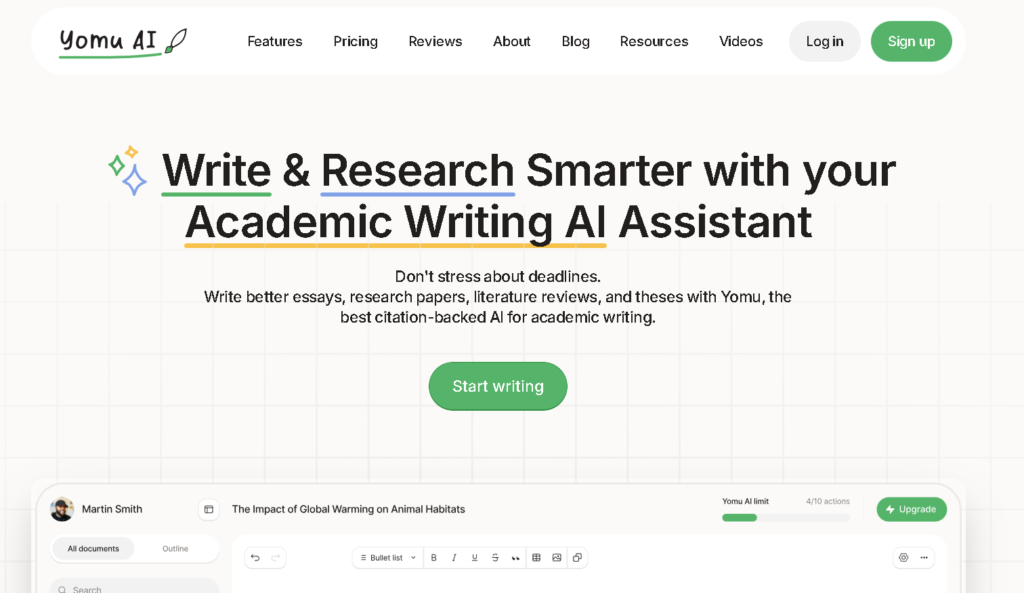
Yomu AI is an AI-powered academic writing and research assistant designed to help students, researchers, academics, and other writers create, improve, and organize scholarly content. It combines AI writing assistance with academic research tools, document analysis, and intelligent editing features to make the academic writing process faster and more efficient.
From drafting and rewriting to working with PDFs, images, citations, and research materials, Yomu AI provides a centralized workspace for users who want to streamline their academic workflow without constantly switching between different tools.
Yomu AI stands out by combining academic writing, research, AI chat, document analysis, and multiple AI models in a single workspace. Instead of using one tool for writing, another for research, and another for analyzing PDFs, users can manage many parts of the academic workflow from one platform.
Its focus on academic creators also makes it different from general AI writing assistants. The platform is designed around research-heavy workflows where users need to work with academic information, documents, sources, and structured writing.
Yomu AI’s interface is designed around guided academic workflows, making it possible for new users to explore its writing, research, document-chat, and AI features progressively. Users can experiment with different workflows to find the best approach for essays, papers, research projects, and other academic content.
Yomu AI is an AI-powered academic writing and research assistant that helps users write, research, analyze documents, and work with academic content.
Yomu AI is primarily designed for students, researchers, academic writers, and other users who regularly create research-based content.
Yes. Yomu AI supports smart chat with PDFs, allowing users to work with research documents and ask questions about their contents.
Yes. The platform includes academic and web search capabilities designed to support research workflows.
The supplied pricing information lists different AI models across its Pro and Ultra plans, including GPT, Claude, Gemini, Muse, Grok, DeepSeek, and Kimi models.
The supplied pricing shows Pro at $21/month and Ultra at $35/month, billed monthly, with annual billing and promotional savings also advertised.
The Ultra plan includes unlimited AI actions, while the Pro plan includes 1,000 AI actions per month.
Yes. Its features are specifically focused on academic writing, research, AI-assisted editing, document analysis, and working with academic sources. Users should still fact-check and review AI-generated content before submitting academic work.
| Criteria | Rating |
|---|---|
| Accuracy and Reliability | ⭐ 4.6/5 |
| Ease of Use | ⭐ 4.6/5 |
| Functionality and Features | ⭐ 4.7/5 |
| Performance and Speed | ⭐ 4.5/5 |
| Customization and Flexibility | ⭐ 4.5/5 |
| Data Security & Privacy | ⭐ 4.5/5 |
| Support and Resources | ⭐ 4.4/5 |
| Value for Money | ⭐ 4.6/5 |
| Integration Capabilities | ⭐ 4.3/5 |
EarnDraft is an AI ebook creator that turns a one-line idea into a complete outline, five written chapters,…

Perplexity AI is an intelligent AI search and research platform designed to replace traditional search engines with conversational,…

Bing AI, now integrated into Microsoft Copilot, is an AI-powered assistant that combines web search, content generation, coding…

Jasper AI is a marketing-focused AI platform built to run end-to-end marketing workflows through purpose-built AI agents —…

QuillBot is an AI-powered writing platform built around one core strength — paraphrasing — and expanded into a…

TeamPost is an AI LinkedIn ghostwriter built for teams. Every employee gets their own AI ghostwriter that learns…
Genei is an AI-powered research and summarisation tool that helps students, academics, journalists, and professional writers work through background…

DeepSeek is an advanced AI platform developed by DeepSeek AI, offering powerful large language models (LLMs) for chat,…
HyperWrite is an AI-powered writing and research assistant designed to help users write faster, research information, and improve…

SellyAI is an AI-powered product listing generator that turns a photo, a product URL, or a few typed words…
AI Text Cleaner is a text-hygiene tool built around four functions: removing invisible/non-printing Unicode characters, cleaning up leftover…
AI Text Watermark Remover is a browser-based tool for cleaning text pasted from ChatGPT, Claude, Gemini, and other…