Turn hours of reading into minutes of insight
Last updated August 31, 2026
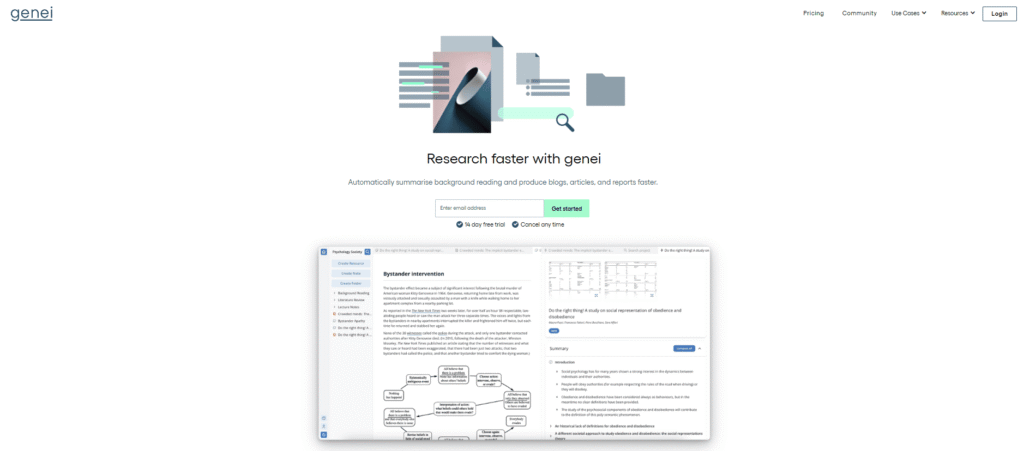
Genei is an AI-powered research and summarisation tool that helps students, academics, journalists, and professional writers work through background reading faster — automatically summarising PDFs and webpages, extracting keywords, answering questions from documents, and helping produce blogs, articles, and reports more efficiently.
Backed by Y-Combinator (Summer 2021), featured as a TechCrunch favourite startup, and winner of the Oxford University All Innovate 2020 competition, Genei was built to solve one of the most time-consuming parts of research and writing: reading and synthesising large volumes of source material. Instead of spending hours reading through papers and articles to find the key points, Genei’s AI reads them for you — surfacing the most important information, generating summaries, extracting keywords, and letting you ask questions directly to your documents.
Genei is particularly strong for students and academics who need to process large reading lists quickly, journalists and content writers who need to research topics efficiently before writing, and professionals who regularly work with reports, whitepapers, and research documents. The platform also now supports qualitative research through its companion tool CoLoop.
Genei offers a 14-day free trial with no credit card required. Academic pricing with a 40% discount is available for students. Plans start from £3.99/month (annual).
Pros
Cons
Students and PhD researchers — Genei’s combination of AI summarisation, keyword extraction, multi-document analysis, citation management, and student discounts (40% off) makes it one of the most accessible and affordable AI research tools for academic users. The 14-day free trial lets students test it before committing.
Journalists and content writers — Genei was compared to Grammarly by TechCrunch’s Senior Reporter — it fits naturally into writing workflows by helping researchers process background reading faster and produce articles and reports more efficiently. The Chrome extension is particularly useful for journalists who research across multiple web sources.
Academic researchers and lecturers — Use Genei to process large volumes of papers and reports, extract key themes, and generate summaries for literature reviews and research briefs. Multi-document analysis across an entire reading list is the core time-saving feature.
Business analysts and consultants — Process industry reports, whitepapers, and research documents faster. Genei’s document management system with projects and folders keeps research organised across multiple client engagements.
Qualitative researchers — Genei’s companion tool CoLoop extends the platform into qualitative research analysis — useful for researchers working with interview transcripts, focus group data, and other qualitative sources.
Uncommon use cases: Using Genei’s Chrome extension to build a curated research library from web browsing sessions; using multi-document analysis to identify common themes across a set of competitor reports; using the citation generator to automatically format references from uploaded PDFs.
| Feature | Genei | Elicit | Scite |
|---|---|---|---|
| Primary focus | PDF and webpage summarisation + research writing | Systematic reviews + research agent | Citation verification + evidence quality |
| AI summarisation | ✅ Yes — PDFs and webpages | ✅ Yes — paper summaries | ✅ Yes — AI assistant |
| Multi-document analysis | ✅ Yes (Pro) | ✅ Yes — up to 20,000 data points | ❌ No |
| Academic database search | ❌ No — upload only | ✅ Yes — 138M+ papers | ✅ Yes — 300M+ sources |
| Smart Citations | ❌ No | ❌ No | ✅ Yes — supported/contradicted |
| Citation management | ✅ Yes — built-in | ❌ No | ❌ No |
| Chrome extension | ✅ Yes | ❌ No | ❌ No |
| Keyword extraction | ✅ Yes — AI-powered | ❌ No | ❌ No |
| Paraphrasing and rephrasing | ✅ Yes (Pro) | ❌ No | ❌ No |
| Systematic review automation | ❌ No | ✅ Yes — PRISMA 2020 | ❌ No |
| Question answering | ✅ Yes — from uploaded docs | ✅ Yes — from 138M+ papers | ✅ Yes — from 300M+ sources |
| Student discount | ✅ Yes — 40% off | ❌ No | ✅ Yes — available |
| 14-day free trial | ✅ Yes | ❌ No (free plan) | ✅ Yes — 7 days |
| Paid from | £3.99/mo (annual academic) | $49/user/mo (annual) | $20/mo (annual) |
| Best for | Students, writers, document summarisation | Pharma, systematic reviews, data extraction | Citation quality, evidence verification |
Choose Genei if: You need an affordable, accessible AI tool for summarising PDFs and webpages, extracting keywords, managing citations, and writing faster — especially as a student or content writer. Genei is the most budget-friendly option in this category and the only one with a built-in Chrome extension and citation management.
Choose Elicit if: You need systematic literature review automation, PRISMA 2020 compliance, large-scale data extraction from academic databases, or a Research Agent for pharmaceutical and biomedical research. Elicit searches 138M+ papers directly — Genei only works with documents you upload.
Choose Scite if: You need to understand whether scientific findings have been supported or contradicted by later research — Scite’s Smart Citations and 300M+ source database are unique capabilities that Genei doesn’t offer.
Step 1: Start your free trial
Step 2: Create a project and upload documents
Step 3: Generate AI summaries
Step 4: Extract keywords
Step 5: Ask questions to your documents
Step 6: Use multi-document analysis (Pro)
Step 7: Generate citations and export
Step 8: Install the Chrome extension
| Plan | Monthly Price | Annual Price | Best For |
|---|---|---|---|
| Basic (Academic) | £4.99/mo | £3.99/mo | Students needing AI summaries, keyword extraction, citation management |
| Pro (Academic) | £19.99/mo | £15.99/mo | Students needing multi-document analysis, GPT-3 summaries, paraphrasing |
| Plan | Monthly Price | Annual Price | Best For |
|---|---|---|---|
| Basic (Professional) | £9.99/mo | £7.99/mo | Professionals needing AI summaries, document management, citation tools |
| Pro (Professional) | £29.99/mo | £24.99/mo | Professionals needing multi-document analysis, GPT-3, advanced AI features |
What’s included on Basic (all tiers):
What Pro adds over Basic:
Free trial: 14 days on all plans — no credit card required, cancel anytime.
Student discount: 40% off via Student Beans — academic pricing applied automatically for verified students.
If Genei isn’t the right fit for your research workflow, budget, or use case, here are the closest alternatives worth evaluating:
1. Elicit The most capable AI research tool for systematic literature reviews and high-stakes research decisions. Elicit searches 138M+ academic papers directly — unlike Genei which only works with documents you upload. Better for pharmaceutical researchers, academic systematic reviews, and PRISMA 2020-compliant evidence synthesis. More expensive ($49/user/month annual) but significantly more powerful for structured research workflows.
2. Scite The strongest tool for understanding whether scientific findings hold up over time — Smart Citations show whether later research has supported or contradicted a paper’s claims. Scite searches 300M+ sources with full-text access via publisher agreements. Better for evidence quality assessment and citation verification. Starts at $20/month (annual) with a 7-day free trial.
3. Manus AI A general-purpose autonomous AI agent that handles multi-step research tasks including web research, data analysis, and report generation. Better for general research tasks that go beyond academic literature — business research, competitive analysis, and multi-source synthesis. More expensive but broader in scope than Genei.
4. Writesonic An AI writing platform that generates blog posts, articles, and reports from research inputs. Better for the writing output side of the workflow — if you need to produce polished content from your research rather than just summarise and organise it. Writesonic is stronger for content creation; Genei is stronger for research processing.
5. Copy.ai An AI content and GTM platform better suited for marketing and sales content creation. Relevant for content writers who use Genei for research and need a separate tool for producing marketing copy, social media content, and campaign materials.
6. DeepL Write An AI writing assistant focused on improving clarity, tone, and style of written text. Complementary to Genei — use Genei to research and summarise, then DeepL Write to polish the final output. Better for non-English writers who need multilingual writing assistance.
Browse more tools in AI Tools For Research → and AI Tools For Content Creation →
Verdict: Yes for students and budget-conscious researchers — the most affordable AI research summarisation tool available, with a strong feature set for document-based research workflows.
Genei’s core value proposition is clear: if you have a large reading list of PDFs and webpages and need to process them faster, Genei’s AI summarisation, keyword extraction, multi-document analysis, and citation management deliver genuine time savings at a price point that’s accessible to students and individual researchers.
The Y-Combinator backing, TechCrunch recognition, and Oxford University prize win validate the concept. The 98% user satisfaction rate on time savings and 95% productivity improvement rate are strong signals of real-world value.
The main limitation to be aware of in 2026 is that Genei works only with documents you upload — it doesn’t search academic databases like Elicit (138M+ papers) or Scite (300M+ sources). If you need to discover new papers rather than process ones you already have, Elicit or Scite are better choices. But for processing and synthesising documents you’ve already gathered, Genei is hard to beat at its price point.
Best for: Students, PhD researchers, journalists, content writers, and professionals who need to process large volumes of PDFs and webpages faster — especially those on a budget who want AI summarisation, keyword extraction, and citation management in one affordable tool.
Skip it if: You need to search academic databases directly, conduct PRISMA-compliant systematic reviews, or assess citation quality — Elicit and Scite are better choices for those workflows.
| Criteria | Rating |
|---|---|
| Accuracy & Reliability | ⭐ 4.3/5 |
| Ease of Use | ⭐ 4.7/5 |
| Features & Functionality | ⭐ 4.3/5 |
| Performance & Speed | ⭐ 4.4/5 |
| Customization | ⭐ 4.2/5 |
| Security & Privacy | ⭐ 4.2/5 |
| Customer Support | ⭐ 4.1/5 |
| Value for Money | ⭐ 4.9/5 |
| Integrations | ⭐ 4.0/5 |
What is Genei?
Genei is an AI-powered research and summarisation tool that automatically summarises PDFs and webpages, extracts keywords, enables multi-document analysis, and helps researchers and writers produce blogs, articles, and reports faster. It is Y-Combinator backed and was featured as a TechCrunch favourite startup in 2021.
Is Genei free?
Genei offers a 14-day free trial with no credit card required — cancel anytime. There is no permanent free plan after the trial. Academic plans start from £3.99/month (annual) and professional plans from £7.99/month (annual).
How much does Genei cost?
Genei’s Academic Basic plan is £3.99/month (annual) or £4.99/month (monthly). Academic Pro is £15.99/month (annual) or £19.99/month (monthly). Professional Basic is £7.99/month (annual) or £9.99/month (monthly). Professional Pro is £24.99/month (annual) or £29.99/month (monthly). A 40% student discount is available via Student Beans.
What can Genei summarise?
Genei can summarise any PDF document or webpage. Upload PDFs directly to the platform or paste webpage URLs. The Chrome extension lets you summarise webpages directly from your browser without switching tabs.
What is multi-document analysis in Genei?
Multi-document analysis lets you analyse and summarise across multiple PDFs or webpages simultaneously — identifying common themes, key information, and connections across your entire reading list. Available on Pro plans.
Does Genei search academic databases?
No — Genei works with documents you upload or webpages you provide. It does not search academic databases like Elicit (138M+ papers) or Scite (300M+ sources). If you need to discover new academic papers, Elicit or Scite are better choices.
Does Genei have a Chrome extension?
Yes — Genei’s Chrome extension lets you summarise webpages or save them for later reading directly from your browser as you browse. This is particularly useful for journalists and researchers who gather sources from multiple websites.
Does Genei generate citations?
Yes — Genei has built-in citation management and reference generation. Content can be linked to any part of a document to generate automatic references. This is included on all plans.
Is Genei good for students?
Yes — Genei offers a 40% academic discount via Student Beans, making the Academic Basic plan £3.99/month (annual). The combination of AI summarisation, keyword extraction, citation management, and multi-document analysis makes it one of the most affordable and practical AI research tools for students.
What is CoLoop?
CoLoop is Genei’s companion qualitative research analysis tool — designed for researchers working with interview transcripts, focus group data, and other qualitative sources. It extends Genei’s capabilities beyond quantitative and document-based research into qualitative research workflows.
How is Genei different from Elicit?
Genei works with documents you upload and focuses on summarisation, keyword extraction, and citation management — ideal for processing reading lists and writing faster. Elicit searches 138M+ academic papers directly, automates PRISMA 2020-compliant systematic reviews, and provides a Research Agent for high-stakes research decisions. Genei is more affordable and accessible; Elicit is more powerful for structured academic research.
How is Genei different from Scite?
Genei summarises and analyses documents you upload — it’s a research processing and writing tool. Scite searches 300M+ scholarly sources and shows whether scientific findings have been supported or contradicted by later research through Smart Citations. Scite is for evidence quality assessment; Genei is for document summarisation and research writing.
AnkiDecks AI Flashcard Generator is an AI-powered learning platform that transforms PDFs, lecture notes, YouTube videos, textbooks, presentations,…

SellyAI is an AI-powered product listing generator that turns a photo, a product URL, or a few typed words…

Dubs is an AI-powered video dubbing and subtitle generator designed to help creators, businesses, educators, and marketers produce…
Frase is the content operating system for AI search — a single platform that runs the complete content loop:…

QuillBot is an AI-powered writing platform built around one core strength — paraphrasing — and expanded into a…
ZeroGPT is an AI content detector built to identify text generated by ChatGPT, GPT-5, Gemini, Grok, DeepSeek, Claude,…

Gemini AI is Google’s advanced multimodal artificial intelligence assistant developed by Google DeepMind. It can understand and generate…

Claude AI is a next-generation conversational AI assistant created by Anthropic. Built to help individuals, teams, and businesses,…

AIBase is an independent AI image and video generation workspace that brings text to image, image to image, text to…
AI Text Cleaner is a text-hygiene tool built around four functions: removing invisible/non-printing Unicode characters, cleaning up leftover…

Elicit is the AI research assistant built specifically for scientific research — trusted by over 5 million researchers at leading pharmaceutical…

All-in-one AI study platform for homework help, AI notes, flashcards, quizzes, exam preparation, and academic writing. StudyX is…