
Zanus AI Pricing Breakdown: Is This Private Enterprise AI Worth the Cost? (2027)
If you have been searching for Zanus AI pricing and hitting a wall — you are not alone.…
Read →Marketing a SaaS startup is challenging.
You need to attract the right audience, create content, rank in search engines, generate leads, nurture prospects, convert website visitors, and keep following up with potential customers. At the same time, most early-stage SaaS companies don’t have the budget to hire a large marketing department.
This is where AI marketing for SaaS startups can make a significant difference.
AI marketing tools can help a small team perform tasks that previously required multiple specialists. You can use AI for keyword research, content creation, email campaigns, lead qualification, customer support, personalization, automation, sales follow-ups, video creation, and much more.
But there is one problem.
There are thousands of AI marketing tools available today.
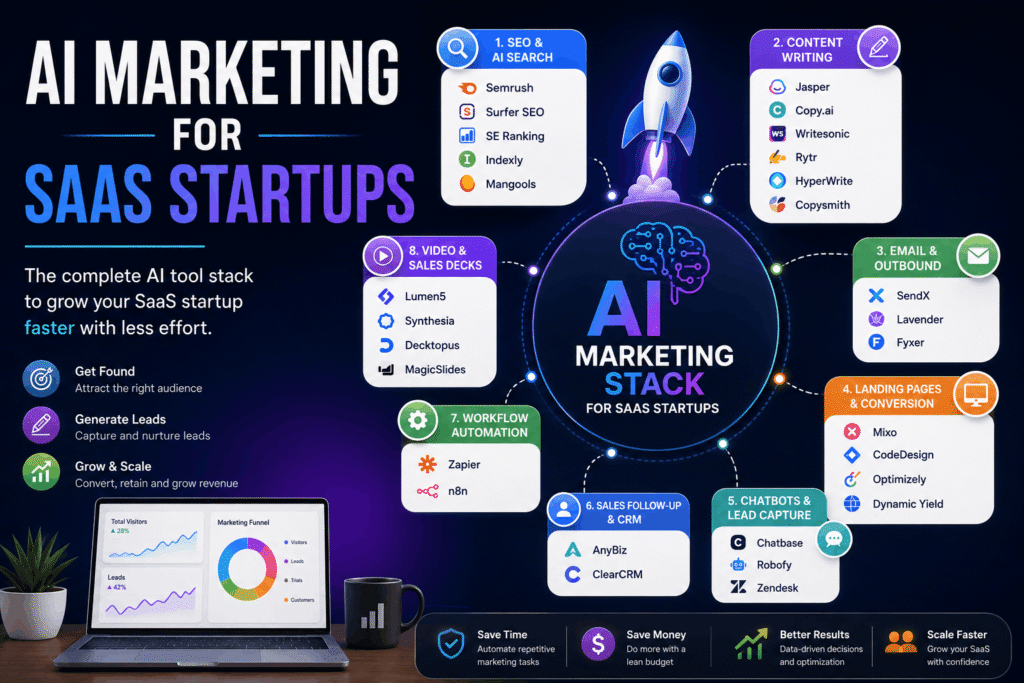
A SaaS founder doesn’t need another list of 50 or 100 AI tools. What you actually need is a practical AI marketing stack that answers three questions:
That’s what this guide covers.
Instead of simply listing software, we’ll build an AI marketing playbook for SaaS startups in 2026, organized around the actual stages of a SaaS marketing funnel.
AI marketing for SaaS startups means using artificial intelligence-powered software to automate, improve, or accelerate marketing activities across the customer journey.
Depending on the startup, an AI marketing stack can support:
The goal isn’t to replace marketing strategy with AI.
The goal is to use AI to execute repetitive work faster while allowing the marketing team to spend more time on strategy, positioning, research, creativity, and customer understanding.
A traditional SaaS marketing team might eventually include:
An early-stage SaaS company may have only one founder and one or two marketers.
AI can help close that execution gap.
For example, one marketer can use an SEO platform to identify opportunities, an AI writing assistant to create the first draft, an automation platform to distribute leads, an AI chatbot to answer common questions, and an email platform to nurture prospects.
This doesn’t mean every startup should buy all of these tools.
In fact, buying too many AI tools is one of the easiest ways for a startup to waste money.
The better approach is to build your stack around your current bottleneck.
Here’s the basic framework:
| Marketing Job | What You Need | Example AI Tools |
|---|---|---|
| SEO | Keyword research, audits, visibility | Semrush, Surfer SEO, SE Ranking |
| Content | Articles, copy, campaigns | Jasper, Copy.ai, Writesonic |
| Automation and outreach | SendX, Lavender, Fyxer | |
| Landing Pages | Fast page creation | Mixo, CodeDesign |
| Conversion | Testing and personalization | Optimizely, Dynamic Yield |
| Lead Capture | Website conversations | Chatbase, Robofy |
| CRM & Sales | Lead management | AnyBiz, ClearCRM |
| Automation | Connect your marketing stack | Zapier, n8n |
| Video | Product and marketing videos | Lumen5, Synthesia |
| Presentations | Sales and investor decks | Decktopus, MagicSlides |
Let’s look at each stage in detail.
SEO remains one of the most valuable acquisition channels for SaaS startups because content can continue attracting visitors long after it is published.
But search is changing.
Your potential customers are no longer relying exclusively on traditional Google results. They may also discover products through AI-powered search and answer engines such as ChatGPT, Gemini, and Perplexity.
That means your SaaS SEO strategy increasingly needs to consider both:
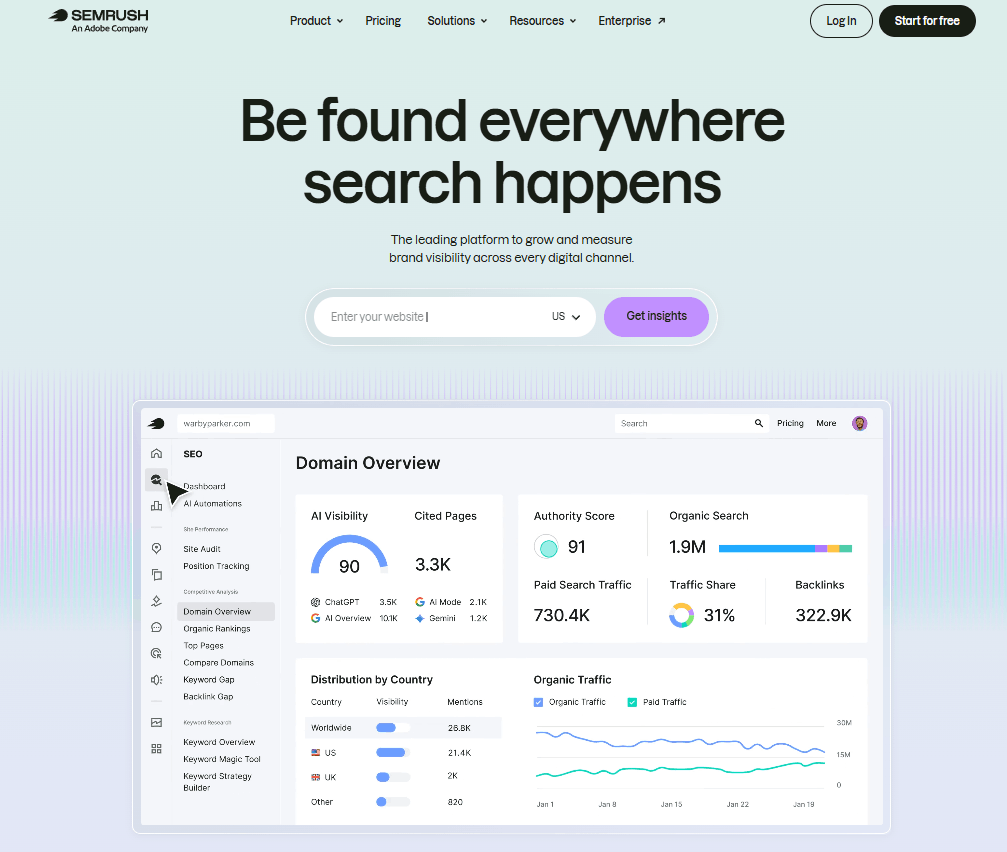
Semrush is a strong option for SaaS teams that want an extensive SEO platform.
It can be useful for:
Best for: SaaS teams looking for an all-in-one SEO platform.
Surfer SEO focuses heavily on content optimization.
It can help marketers understand what topics, keywords, headings, and related concepts should be considered when creating SEO content.
Best for: Content-focused SaaS teams that already have a keyword research process.
Search Atlas combines SEO functionality with AI-powered workflows.
Its automation capabilities can be useful for teams that want to reduce the amount of manual technical SEO work.
Best for: Teams looking for more automated SEO workflows.
SE Ranking is another option for startups that need SEO tracking and competitive research without necessarily choosing the most expensive enterprise platform.
Best for: Small marketing teams that need practical SEO tracking and research.
Indexly can be considered when your focus is monitoring how your brand or content performs across AI search and answer engines.
Best for: Startups specifically interested in AI-search visibility.
Mangools is worth considering when a startup wants a simpler SEO toolkit.
It can be particularly useful for founders and small teams that don’t need an extensive enterprise SEO platform.
Best for: Early-stage SaaS startups with a limited SEO budget.
Don’t immediately subscribe to multiple SEO platforms.
Choose one primary SEO platform and build a repeatable process around it:
Research → Create → Optimize → Publish → Build authority → Monitor → Update
The important thing isn’t how many SEO tools you own.
It’s how consistently you execute the process.
Content is the fuel behind many SaaS marketing channels.
A single piece of research can become:
AI can dramatically speed up this repurposing process.
However, publishing generic AI-generated articles at scale isn’t a sustainable strategy.
Your content should still include:
Jasper is designed around marketing content and brand communication.
It can be useful for teams producing content across multiple marketing channels.
Best for: Marketing teams that need consistent brand voice across campaigns.
Copy.ai is useful for repeatable marketing workflows.
You can use AI workflows for tasks such as:
Best for: Startups that want reusable AI-powered marketing workflows.
Writesonic combines AI writing capabilities with tools focused on search and content visibility.
Best for: SaaS marketers who want content creation and search-focused workflows in one ecosystem.
Rytr can be a practical option for founders who need affordable AI-assisted writing.
Best for: Solo founders and small marketing teams.
HyperWrite works as an AI writing assistant that can support users across different writing tasks.
Best for: Founders and marketers who want AI assistance while writing.
Copysmith is designed for marketing and content workflows and can be useful for teams handling larger volumes of commercial content.
Best for: Marketing teams managing multiple content and ecommerce-style workflows.
Getting someone to visit your website is only the beginning.
A SaaS company also needs to convert visitors into leads and leads into customers.
Email remains an important part of that process.
AI can help with:
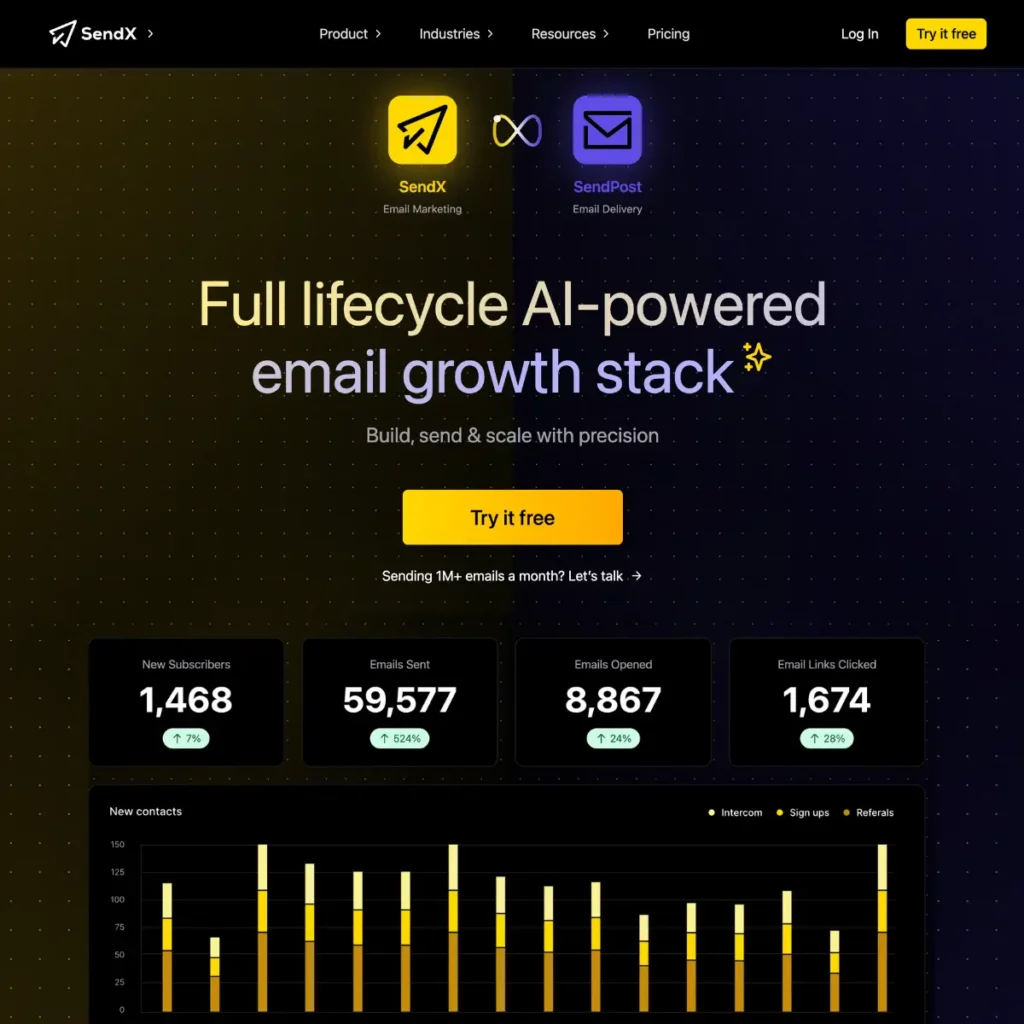
SendX can be useful for startups looking for affordable email marketing automation.
Best for: Early-stage SaaS companies building email campaigns and automation.
Lavender focuses on improving sales emails with AI-assisted writing and recommendations.
Best for: Sales teams and founders doing outbound prospecting.
Fyxer acts as an AI assistant for email and can help with tasks such as organizing inboxes and drafting responses.
Best for: Founders who spend too much time managing email.
A basic SaaS email funnel could look like:
Signup → Welcome Email → Product Education → Use Case → Case Study → Offer → Follow-Up
AI can help create and personalize the content, but the strategy should come from your understanding of your customer.
Explore more tools in AI Tools For Email Marketing.
You can generate thousands of visitors and still have a poor marketing strategy if your website doesn’t convert them.
Your landing page needs to communicate:
AI website builders can help startups move faster.
Mixo can generate a landing page from a product concept or short description.
Best for: Pre-launch startups that need an MVP landing page quickly.
CodeDesign provides AI-assisted website creation capabilities beyond a simple one-page site.
Best for: Startups building more complete web experiences.
Dynamic Yield focuses on personalization and optimization.
Best for: Growing companies with enough traffic to benefit from sophisticated personalization.
Optimizely is well known for experimentation and conversion optimization.
Best for: SaaS companies with enough traffic and conversions to run meaningful experiments.
A common startup mistake is trying to A/B test everything before generating enough traffic.
If you have 300 visitors per month, your priority probably shouldn’t be advanced personalization.
Focus first on:
Traffic → Message → Product Value → Conversion
Then introduce sophisticated experimentation when the data supports it.
Your website should not simply provide information.
It should help visitors take the next step.
AI chatbots can answer questions, guide users toward relevant resources, qualify prospects, and capture leads.
Chatbase allows businesses to create AI-powered chatbots based on their own information and documentation.
Best for: SaaS startups that want an AI product assistant or website chatbot.
Robofy provides an easier way to create and deploy AI chatbot experiences.
Best for: Small businesses and startups looking for a quick implementation.
Zendesk becomes more relevant as support volume grows and a startup needs a broader customer service platform.
Best for: SaaS companies moving from a basic chatbot toward a full customer support operation.
Don’t simply tell your chatbot to “answer everything.”
Give it clear responsibilities:
A focused chatbot generally provides a better experience than one with no defined purpose.
Marketing generates leads.
Sales turns qualified leads into revenue.
The problem is that startups often lose leads because nobody follows up consistently.
AI-powered sales tools can help with:
AnyBiz focuses on AI-powered sales and outreach automation.
Best for: Small teams looking to automate parts of outbound sales.
ClearCRM can provide a lighter CRM layer for startups that don’t want the complexity of a large enterprise CRM.
Best for: Small teams that need straightforward lead management.
At the beginning, your CRM mainly needs to answer:
Build the process first.
Add complexity later.
Automation is the connective tissue between your marketing tools.
Imagine this:
A visitor submits a demo form.
Without automation, someone might need to:
With automation, the entire workflow can happen automatically.
Zapier is one of the easiest automation platforms for connecting marketing applications.
Best for: Non-technical founders and marketers who need to connect many SaaS applications quickly.
Example:
Website Form → Zapier → CRM → Email → Slack Notification
n8n is particularly interesting for technical teams that want greater control over their workflows.
It can be useful when workflows become more complex or when teams want greater control over their infrastructure.
Best for: Technical SaaS teams and developers.
Explore more options in AI Tools For Automation.
Video has become an important part of SaaS marketing.
You can use video for:
Lumen5 can transform written content into video-based marketing content.
Best for: SaaS marketers repurposing blog posts and written content into videos.
Synthesia focuses on AI-generated presenter and avatar videos.
Best for: Product education, internal training, sales enablement, and marketing videos without traditional filming.
Decktopus can help create presentations and decks using AI.
Best for: Sales teams and founders who frequently need presentations.
MagicSlides can turn information or outlines into presentation-style content.
Best for: Quickly creating sales, educational, and business presentations.
The biggest mistake is buying tools before identifying your bottleneck.
Instead, follow this process.
Ask:
What is stopping growth right now?
If nobody can find your website, invest in SEO.
If you’re getting traffic but not producing enough content, invest in content tools.
If you’re getting leads but losing them, improve CRM and email automation.
If your website receives traffic but doesn’t convert, focus on conversion optimization.
Avoid buying five tools that do the same thing.
For example:
SEO: Semrush
Content: Jasper
Automation: Zapier
Chatbot: Chatbase
Email: SendX
That’s already a functional marketing stack.
You don’t need 30 subscriptions.
Your tools become significantly more valuable when they communicate with each other.
For example:
SEO Tool → Content Tool → Website → Lead Capture → CRM → Email Automation → Sales
The objective is to create a system rather than a collection of disconnected applications.
Document your processes.
For example:
Keyword Research
↓
Search Intent Analysis
↓
Content Brief
↓
AI-Assisted First Draft
↓
Expert Review
↓
SEO Optimization
↓
Publish
↓
Internal Linking
↓
Distribution
↓
Performance Monitoring
This is much more valuable than simply asking AI to “write a blog post.”
Not every marketing task should be automated.
The best SaaS marketing teams will not be “AI-only.”
They will be AI-assisted.
If you’re running a SaaS startup with one to three people, you don’t need an enterprise marketing stack.
Start small.
Choose one:
Your goal is to understand what your audience searches for and create content around those opportunities.
Choose one:
Use AI for research assistance, outlining, drafting, repurposing, and optimization.
Don’t publish everything AI generates without reviewing it.
Choose one:
Make sure your website gives interested visitors an easy way to ask questions or contact you.
Choose one:
Connect your forms, CRM, email, notifications, and other marketing applications.
Only after traffic and lead volume increase should you consider adding:
Here’s a practical example:
| Function | Starter Choice | Purpose |
| SEO | Mangools / SE Ranking | Keyword and ranking research |
| Content | Rytr / Copy.ai | AI-assisted content |
| Optimization | Surfer SEO | Content optimization |
| SendX | Email campaigns | |
| Chatbot | Chatbase | Lead capture |
| Automation | Zapier | Connect applications |
| Sales | ClearCRM | Manage leads |
| Video | Lumen5 | Content repurposing |
| Presentations | MagicSlides | Sales decks |
You don’t need every tool.
Choose according to your current growth stage.
One of the most common questions from SaaS founders: how much should I budget for AI marketing tools?
Here’s a realistic cost breakdown for a lean 1–3 person SaaS team:
Starter Stack (~$50–100/month):
| Tool | Function | Cost |
|---|---|---|
| Mangools or SE Ranking | SEO research | $29–49/month |
| Rytr | AI content writing | $9/month |
| Chatbase | AI lead capture chatbot | Free–$19/month |
| Zapier (Starter) | Automation | $19/month |
| SendX | Email marketing | $9.99/month |
| Total | ~$67–106/month |
Growth Stack (~$150–250/month):
| Tool | Function | Cost |
|---|---|---|
| Semrush | Full SEO platform | $139/month |
| Jasper or Copy.ai | AI content + workflows | $49–59/month |
| Chatbase Pro | Advanced chatbot | $49/month |
| Zapier (Professional) | Advanced automation | $49/month |
| SendX | Email marketing | $9.99/month |
| Total | ~$296–306/month |
The rule: Don’t buy the Growth Stack until you have consistent traffic and leads. Start with the Starter Stack, prove the channel works, then upgrade.
There is no universal number.
Your AI marketing budget should depend on:
For an early-stage startup, a lean approach is usually better.
Instead of spending hundreds or thousands of dollars across dozens of tools, start with a few core applications.
For example:
SEO + Content + Automation + Lead Capture
Then add tools as a specific bottleneck appears.
The goal is not to maximize your software budget.
The goal is to maximize marketing output and revenue per dollar spent.
More tools don’t automatically mean better marketing.
Every additional platform creates:
Start with the minimum viable stack.
Search engines and customers don’t need another generic article that says the same thing as every competitor.
Use AI to accelerate research and production, but add:
Automation is useful when it removes repetitive work.
It becomes harmful when it removes human judgment.
Your customer should still feel like they’re interacting with a company that understands their problem.
Traffic isn’t revenue.
If your website gets visitors but your messaging is unclear, adding another traffic-generation tool won’t solve the underlying problem.
Don’t optimize your AI stack around:
Instead, measure:
A simple framework is:
AI Marketing ROI = Incremental Revenue − Marketing Cost / Marketing Cost
But SaaS companies should go deeper.
Track the entire funnel:
Impressions → Visitors → Leads → Trials → Activated Users → Customers → Revenue
Then ask which AI-assisted activities are improving each stage.
For example:
If AI helps your team publish twice as much content but qualified traffic doesn’t increase, the workflow needs improvement.
If AI helps your sales team respond faster and conversions increase, that automation is creating measurable value.
AI doesn’t replace traditional marketing fundamentals.
Instead, it changes the economics of execution.
| Traditional Approach | AI-Assisted Approach |
| Manual keyword research | AI-assisted research |
| Manual content drafts | AI-assisted drafts |
| Manual personalization | Automated personalization |
| Manual lead qualification | AI-assisted qualification |
| Manual follow-ups | Automated sequences |
| Manual reporting | Automated reporting |
| Manual video production | AI-assisted video creation |
| Manual customer support | AI-powered first-line support |
The strategy remains human.
The execution becomes faster.
The SaaS marketing stack is moving toward increasingly connected systems.
Instead of using AI tools independently, startups will increasingly connect:
AI Search → SEO → Content → Website → Chatbot → CRM → Email → Sales → Analytics
This creates a marketing system where data can move between different stages of the customer journey.
AI agents and automation will also take on more repetitive marketing tasks.
However, the companies that win won’t necessarily be the ones using the most AI.
They’ll be the ones that combine AI with:
AI can accelerate a good marketing strategy.
It can also accelerate a bad one.
That’s why strategy comes first.
If you want the simplest possible starting point, use this framework:
Choose Semrush, SE Ranking, Mangools, or Surfer SEO.
Choose Jasper, Copy.ai, Writesonic, or Rytr.
Choose SendX or another email platform that fits your audience and volume.
Choose Chatbase or Robofy.
Choose Zapier if simplicity is your priority, or n8n if you want greater technical control.
Choose Lumen5 or Synthesia, depending on whether you need content repurposing or AI presenters.
Start with a simple CRM and add AI-powered sales automation when lead volume justifies it.
The best AI marketing stack for startups isn’t the stack with the most tools.
It’s the stack that solves your biggest marketing problems with the fewest unnecessary subscriptions.
For most early-stage SaaS companies, the priority should be:
1. Get found → 2. Create useful content → 3. Capture leads → 4. Automate follow-ups → 5. Convert → 6. Measure → 7. Scale
Start with one tool for each critical job.
Build repeatable workflows.
Connect your systems.
Keep humans involved where judgment matters.
Then add more sophisticated AI marketing tools only when your traffic, leads, customers, and revenue justify them.
If you’re building a SaaS company in 2026, AI shouldn’t simply be another line item in your software budget.
It should become part of how your marketing team works.
Before buying any AI marketing tool, run this simple calculation:
Step 1: What is your average customer lifetime value (LTV)? Step 2: What is your current conversion rate from visitor to trial? Step 3: How many additional trials would the tool need to generate to pay for itself?
Example:
If your SEO tool generates 100 additional organic visitors/month and 2 convert to customers, it pays for itself in month 1.
This is why SEO and content tools have the best ROI for early-stage SaaS — the traffic compounds over time, unlike paid ads which stop the moment you stop paying.
Start with one SEO or content optimization tool, one AI writing tool, one automation platform, and a lead-capture solution such as an AI chatbot. This gives a small team a practical foundation without creating unnecessary software costs.
The best tool depends on your marketing bottleneck. Semrush and SE Ranking are useful for SEO, Jasper and Copy.ai for marketing content, SendX for email marketing, Chatbase for AI lead capture, Zapier and n8n for automation, and Synthesia or Lumen5 for video.
Start by identifying your biggest marketing bottleneck. Choose one tool for that job, connect it to your existing systems, create a repeatable workflow, measure the result, and only then add another tool.
There is no fixed amount. Early-stage startups should generally keep the stack lean and choose tools based on measurable business needs rather than buying multiple overlapping subscriptions.
AI can automate and accelerate many repetitive marketing tasks, but it doesn’t replace strategy, customer research, positioning, creative judgment, or high-value customer relationships. The strongest approach is usually AI-assisted marketing rather than completely automated marketing.
AI can help with research, outlining, drafting, optimization, and repurposing, but publishing generic AI-generated content without human expertise is unlikely to create a strong competitive advantage. SaaS content should demonstrate experience, expertise, useful information, and original insights.
Not always. Many modern SEO platforms are adding AI-search visibility features, so one platform may cover both traditional SEO and AI-search monitoring. A dedicated AI-search visibility tool can become useful when monitoring AI mentions and citations becomes a major growth priority.
There is no universal answer. For many early-stage SaaS companies, SEO and content can be attractive because useful content can continue generating organic traffic over time. However, the right channel depends on the product, audience, sales cycle, competition, and customer acquisition economics.
Looking for more tools to build your SaaS marketing stack?

If you have been searching for Zanus AI pricing and hitting a wall — you are not alone.…
Read →Searching “free AI video generator no watermark no sign up” usually turns up a wall of listicles promising…
Read →Three tools. Three completely different answers to the same question. The question is: what does “best AI video…
Read →