
8 Best AI Tools to Create a Faceless YouTube Channel Automatically in 2026
You do not need a camera. You do not need a studio. You do not need to show…
Read →There is a reason millions of people use both of these tools every single day.
They are not the same thing. They were never meant to be the same thing. And the people who get the most out of AI in 2026 are not the ones who picked a winner — they are the ones who figured out which tool to open for which job.
Here is the clearest way to think about it:
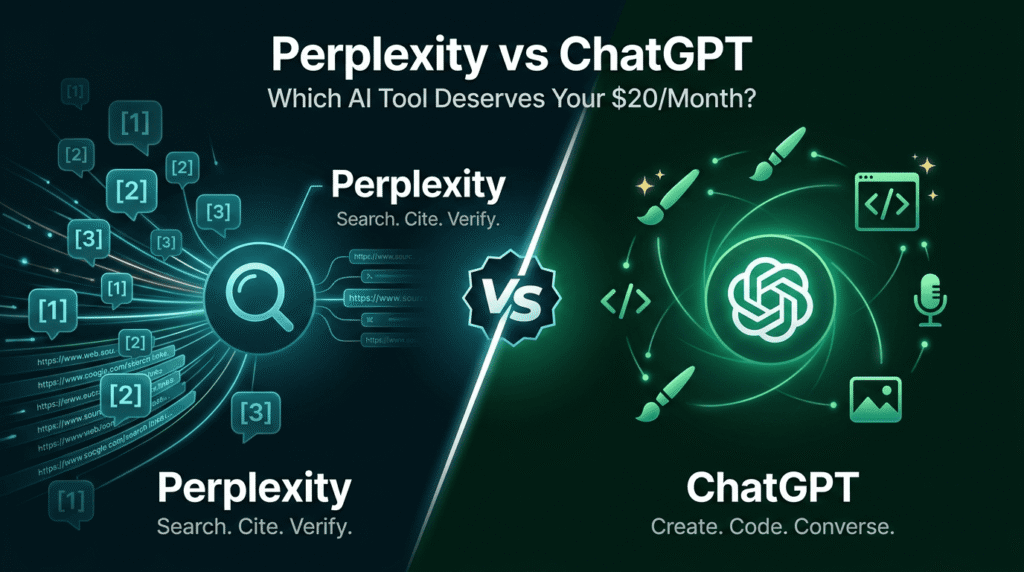
Perplexity searches and cites. ChatGPT thinks and creates.
That one sentence explains 90% of the decisions you need to make. Everything below is the detail that fills in the other 10%.
Most comparisons jump straight to features and pricing. But the reason Perplexity and ChatGPT behave so differently comes down to how they were built — and understanding that saves you from using the wrong tool and blaming the AI when it underperforms.
ChatGPT is generation-first. It was trained on a massive dataset and optimised to produce fluent, coherent, contextually aware text. When you ask it a question, it generates an answer from what it learned during training — and optionally searches the web to supplement that. The web search is an add-on to a generation engine.
Perplexity is retrieval-first. It was built around a RAG (Retrieval-Augmented Generation) pipeline — meaning it searches the web first, retrieves authoritative sources, and then synthesises an answer from what it found. The generation is an add-on to a search engine.
That architectural difference explains everything:
Neither architecture is superior. They are optimised for different jobs.
| Perplexity | ChatGPT | |
|---|---|---|
| Core purpose | AI-powered answer engine | General-purpose AI assistant |
| Default model | Sonar (custom Llama 3.1) | GPT-5.6 Terra |
| Available models | GPT-5.6, Claude Sonnet 4.6, Gemini 3.1 Pro, Nemotron 3, Sonar | GPT-5.6 Sol, Terra, Luna — OpenAI ecosystem only |
| Web search | Always on — every response | Optional — must enable per conversation |
| Citations | Every response, inline numbered | Selective — only when browsing enabled |
| Search accuracy | 92% on real-time queries | 87% on real-time queries |
| Image generation | Pro users — GPT Image 1, Nano Banana, Seedream 4.5 | DALL-E + GPT-5 native — best in class |
| Voice mode | Basic — queries only | Advanced Voice Mode — real-time conversation |
| Coding | Documentation lookup only | Full execution, debugging, sandbox |
| Persistent memory | No — session-based only | Yes — learns across conversations |
| Agentic AI | Perplexity Computer (Max only) | ChatGPT Agent — Plus and above |
| AI browser | Comet — free, all platforms | Atlas — macOS only, Chromium-based |
| Video generation | Yes — up to 8 seconds (Pro/Max) | No |
| Custom agents | Spaces | Custom GPTs — 500+ ecosystem |
| Free plan | Unlimited basic searches | Limited GPT-5.3 access |
| Paid entry | $20/month (Pro) | 20/month (Plus) |
| G2 rating | 4.5/5 | 4.7/5 |
Both cost $20 a month. Both are worth it. But they are worth it for completely different reasons.
The headline feature is multi-model access — a single subscription gives you GPT-5.6, Claude Sonnet 4.6, Claude Opus 4.6, Gemini 3.1 Pro, Nemotron 3 Super, and Perplexity’s own Sonar models. You switch between them per query based on what the task needs. No other tool at this price point offers that.
The research features are where Perplexity Pro genuinely earns its money:
Premium Sources — access to paywalled data from Statista, PitchBook, and CB Insights through your 199/month. PitchBook costs thousands per year. Getting that data through Perplexity Pro is one of the most underrated value propositions in AI tooling right now.
Perplexity Academic — restricts your search to scholarly sources only. For researchers, students, and anyone who needs peer-reviewed citations rather than blog posts, this is a feature that has no equivalent in ChatGPT.
Deep Research mode — performs dozens of searches, reads hundreds of sources, and synthesises a comprehensive report autonomously. Faster than ChatGPT’s equivalent for data-heavy research. Less strategic and narrative-driven than ChatGPT’s version.
Create files and apps (formerly Perplexity Labs) — goes beyond text to produce multimedia research projects with custom charts, visual organisation, and gathered assets. The output looks more like data journalism than a chatbot response.
300+ Pro searches per day with the ability to choose your model for each one.
ChatGPT Plus is the broadest AI toolkit available at this price point. The feature list is longer than Perplexity’s — but it is wide rather than deep.
GPT-5.4 Thinking — the most capable OpenAI model, with chain-of-thought reasoning for complex multi-step problems. Perplexity gives you access to GPT-5.6 for search queries, but ChatGPT’s deep integration with its own models gives it an edge on tasks that require extended reasoning.
DALL-E + GPT-5 image generation — the best image generation of any AI assistant at this price point. Perplexity has image generation on Pro, but ChatGPT’s is significantly more capable and more deeply integrated into the conversation workflow.
Advanced Voice Mode — real-time voice conversation with the ability to answer questions about what you see. Perplexity has voice mode for queries but nothing comparable to ChatGPT’s conversational voice experience.
ChatGPT Agent — navigates websites, fills out forms, runs code, and completes multi-step tasks autonomously. Available on Plus and above.
Persistent memory — ChatGPT learns your preferences, writing style, and context across conversations. Perplexity has no persistent memory — every session starts fresh.
Custom GPTs — build or use specialised AI agents with custom instructions, knowledge bases, and integrations. The GPT ecosystem has 500+ tools built by third parties.
Deep Research — produces strategic, narrative-driven research reports. Takes longer than Perplexity’s version but delivers something closer to an executive briefing than a data dump.
10 Deep Research runs per month on Plus. Unlimited on Pro ($100/month).
If your primary use is research, fact-checking, and sourcing — Perplexity Pro is the better $20. The multi-model access alone is worth it if you would otherwise pay for separate Claude or Gemini subscriptions.
If your primary use is writing, coding, image generation, and creative work — ChatGPT Plus is the better $20. The breadth of the toolkit is unmatched at this price point.
If you do both — and most professionals do — run both for $40/month. That is less than most professional software subscriptions and covers every AI use case you will encounter.
| Plan | Price | Key Features |
|---|---|---|
| Free | $0 | Unlimited basic searches, limited Pro searches per day, basic file uploads |
| Pro | $20/month | 300+ Pro searches/day, all frontier models, Premium Sources, Deep Research, image generation, video clips |
| Max | $200/month | Unlimited Pro searches, Model Council, Perplexity Computer (19-model agent), Labs access, early features |
| Enterprise Pro | $40/user/month | Team collaboration, admin controls, no training on company data |
| Enterprise Max | $325/user/month | Maximum limits, highest security, advanced enterprise features |
| Plan | Price | Key Features |
|---|---|---|
| Free | $0 | GPT-5.3 access, limited messages, limited image generation |
| Go | $8/month | More messages, larger context window, ad-supported |
| Plus | $20/month | GPT-5.4 Thinking, DALL-E, Advanced Voice, Agent Mode, 10 Deep Research runs, Custom GPTs |
| Pro | $100/month | 5x Plus usage, GPT-5.4 Pro reasoning, unlimited image generation, unlimited Deep Research |
| Team | $25/user/month | Shared workspace, admin controls, higher limits |
| Enterprise | Custom | Maximum security, compliance, custom integrations |
The pricing gap that matters for teams: ChatGPT Team at 40/user/month — a 37.5% cost difference. For a 20-person team, that is $3,600/year. For teams where research is the primary use case, Perplexity’s enterprise features justify the premium. For general-purpose teams, ChatGPT’s lower per-seat cost is hard to argue with.
This is the category that defines Perplexity’s existence. And the data backs it up.
In independent benchmarks, Perplexity achieves 92% factual accuracy on real-time queries versus ChatGPT’s 87%. That 5-point gap sounds small until you consider what it means in practice: for every 100 factual claims you need to verify, Perplexity gets 5 more right. For researchers, journalists, and analysts where accuracy directly affects their work, that gap is significant.
The citation quality difference is even more pronounced. Perplexity provides inline numbered citations on every response — you can click any claim and go directly to the source. ChatGPT provides citations selectively when web browsing is enabled, and the sources are not always authoritative. In one tested query about NASA’s Mars rover, Perplexity sourced almost exclusively from NASA and peer-reviewed scientific publications. ChatGPT’s sources included the New York Post and SlashGear.
Perplexity’s search focus modes add another layer of precision:
ChatGPT has no equivalent focus mode system. Its web search is general-purpose and cannot be restricted to specific source types.
The one caveat worth noting: Perplexity’s free tier steers users toward its own Sonar model, which is less capable than the frontier models available on Pro. Some users on Reddit’s Perplexity community have noted frustration with model availability changing without warning. On the Pro plan, this is less of an issue — but it is worth knowing before you subscribe.
There are categories where ChatGPT does not just lead — it leads by enough that Perplexity is not a serious alternative.
Coding. ChatGPT executes Python code directly in the interface, debugs errors, builds functional applications, and integrates with Codex for agentic coding workflows. Perplexity can explain code and look up documentation. For any serious development work, ChatGPT is the only choice between the two.
Image generation. ChatGPT’s DALL-E and GPT-5 native image generation is best-in-class among AI assistants. Perplexity has image generation on Pro using GPT Image 1, Nano Banana, and Seedream 4.5 — functional but not in the same league for quality or workflow integration.
Voice mode. ChatGPT’s Advanced Voice Mode supports real-time conversation, can answer questions about what you see through your camera, and maintains conversational context naturally. Perplexity’s voice mode handles queries but is not designed for extended voice conversations.
Persistent memory. ChatGPT learns your preferences, writing style, and context across every conversation. It remembers that you prefer bullet points, that you are working on a specific project, that you want responses in a certain tone. Perplexity starts fresh every session — no memory, no personalisation over time.
Long-form creative writing. ChatGPT produces the most natural, least AI-sounding long-form prose of any tool at this price point. Perplexity’s writing is competent but research-oriented — it reads like a synthesis document rather than a piece of writing.
Data analysis. ChatGPT executes code on uploaded files, produces interactive charts, and runs statistical analysis directly in the interface. Perplexity can analyse files and provide insights but cannot execute code or produce visualisations.
Both platforms launched autonomous AI agents in 2026. They work differently and target different use cases.
Perplexity Computer (Max plan only — $200/month) orchestrates work across 19 models in parallel, matching each task to the best available model. It is designed for complex research and design projects that require multiple AI capabilities in a single workflow. Think of it as a research director that assigns subtasks to specialist models and synthesises the results.
ChatGPT Agent (Plus and above) navigates websites, fills out forms, runs code, connects to external apps, and completes multi-step tasks from a single conversational instruction. It is more of a general-purpose task executor — less specialised for research, more capable for operational tasks like booking, form-filling, and workflow automation.
Comet — Perplexity’s AI browser — is free on iOS, Android, Windows, and Mac. It has Deep Research integration, voice mode, and agentic task automation built into the browsing experience. Available to all users, not just paid subscribers.
ChatGPT Atlas — ChatGPT’s AI browser — is currently macOS only and Chromium-based. It has a built-in ChatGPT sidebar, browser memory, and Agent Mode for task automation. More limited in platform availability than Comet.
Available only on the Max plan at $200/month, Model Council is genuinely unique.
Instead of trusting a single AI model to answer a high-stakes question, Model Council runs your query across multiple frontier models simultaneously — GPT-5.6, Claude Opus 4.6, Gemini 3.1 Pro — and shows you where they agree and where they diverge.
For decisions where being wrong has real consequences — investment analysis, medical research, legal interpretation, strategic planning — knowing that three independent AI systems reached the same conclusion is meaningfully more reliable than trusting one. And knowing where they disagree tells you exactly where to apply human judgment.
No other AI tool at any price point offers this. It is the most intellectually honest feature in the AI assistant market right now.
Open Perplexity when:
Open ChatGPT when:
Use both when:
The most productive AI users in 2026 are not debating which tool is better. They built a workflow that uses each tool for what it does best.
Step 1 — Research phase: Open Perplexity. Search your topic. Use Academic mode if you need scholarly sources. Use Premium Sources if you need market data. Save the key findings, statistics, and citations.
Step 2 — Creation phase: Open ChatGPT. Paste your Perplexity research as context. Ask it to write the article, report, email, or analysis. Use its memory of your writing style and preferences to get output that sounds like you.
Step 3 — Verification: If ChatGPT adds claims you did not source from Perplexity, go back to Perplexity to verify them before publishing.
This workflow takes the best of both tools and eliminates the weaknesses of each. Perplexity’s research accuracy prevents ChatGPT hallucinations. ChatGPT’s writing quality elevates Perplexity’s dry synthesis into something readable and useful.
Total cost: $40/month. Total productivity gain: significant.
Is Perplexity better than ChatGPT for research?
Yes — by a measurable margin. Perplexity achieves 92% factual accuracy on real-time queries versus ChatGPT’s 87%, provides inline citations on every response, and offers domain-specific search modes for academic, financial, and patent research. For any work where source verification matters, Perplexity is the stronger tool.
Is Perplexity Pro worth $20 a month?
Yes, if research is a regular part of your workflow. The multi-model access alone — GPT-5.6, Claude Opus 4.6, Gemini 3.1 Pro in one subscription — is worth it if you would otherwise pay for separate AI subscriptions. The Premium Sources access to Statista, PitchBook, and CB Insights data is genuinely valuable for business and market research.
Does Perplexity use ChatGPT’s technology?
Perplexity is an independent company with its own proprietary Sonar models. However, Perplexity Pro subscribers can choose to use OpenAI’s GPT-5.6 models for their queries — the same models that power ChatGPT. The key difference is that Perplexity wraps those models in its search-and-citation architecture, so even when using GPT-5.6, the output is formatted with sources and citations in Perplexity’s style.
What is Perplexity Model Council?
Model Council is a Max plan feature ($200/month) that runs your query across multiple frontier models simultaneously — GPT-5.6, Claude Opus 4.6, Gemini 3.1 Pro — and synthesises the results, showing where models agree and where they diverge. For high-stakes decisions where accuracy is critical, it is the most reliable AI research feature available at any price point.
Can ChatGPT replace Google Search?
ChatGPT can supplement Google Search but has limitations as a direct replacement — its web search is optional rather than default, citations are inconsistent, and source authority varies. Perplexity is a more direct Google replacement — it was designed as an answer engine with always-on web search and mandatory citations. Many users have replaced Google with Perplexity for factual queries while keeping ChatGPT for creative and analytical work.
Which is better for students — Perplexity or ChatGPT?
Perplexity is better for research and fact-checking — the Academic mode restricts results to scholarly sources, which is exactly what academic work requires. ChatGPT is better for writing essays, understanding complex concepts through conversation, and working through problem sets. Most students benefit from using both: Perplexity for sourcing, ChatGPT for writing and explanation.
What is Perplexity Computer?
Perplexity Computer is an agentic AI feature available on the Max plan ($200/month) that orchestrates work across 19 AI models in parallel, matching each subtask to the best available model. It handles complex research and design projects end-to-end from a single conversational instruction. It is Perplexity’s answer to ChatGPT Agent, but optimised for research-intensive workflows rather than general task automation.
Is ChatGPT free to use in 2026?
Yes. ChatGPT has a free tier with access to GPT-5.3, limited messages, and limited image generation. ChatGPT Go at 20/month is the most popular paid plan with full GPT-5.4 access, DALL-E, Advanced Voice, and Agent Mode.
Which AI tool is better for journalists and fact-checkers?
Perplexity — without question. The combination of always-on web search, inline citations on every claim, authoritative source prioritisation, and Academic/Finance focus modes makes it the most reliable AI tool for journalism and fact-checking. ChatGPT’s tendency to generate plausible-sounding but unverified claims makes it a liability for work where accuracy is non-negotiable.
Should I pay for Perplexity or ChatGPT first?
Pay for Perplexity first if research and sourcing is your daily bottleneck. Pay for ChatGPT first if writing, coding, image generation, or creative work is your primary use case. If you can afford $40/month, subscribe to both — the combination covers every AI use case a professional will encounter and the workflow synergy between the two tools is genuinely greater than either alone.
Related: ChatGPT vs Claude vs Gemini 2026 → | Grok vs ChatGPT → | Cursor vs GitHub Copilot → | Jasper vs Copy.ai vs Writesonic → | Browse AI Chatbots →

You do not need a camera. You do not need a studio. You do not need to show…
Read →Two tools. Both edit video with AI. Both have millions of users who swear by them. And yet…
Read →From a distance, all three look identical. All three generate marketing copy. All three claim to save you…
Read →