
8 Best AI Tools to Create a Faceless YouTube Channel Automatically in 2026
You do not need a camera. You do not need a studio. You do not need to show…
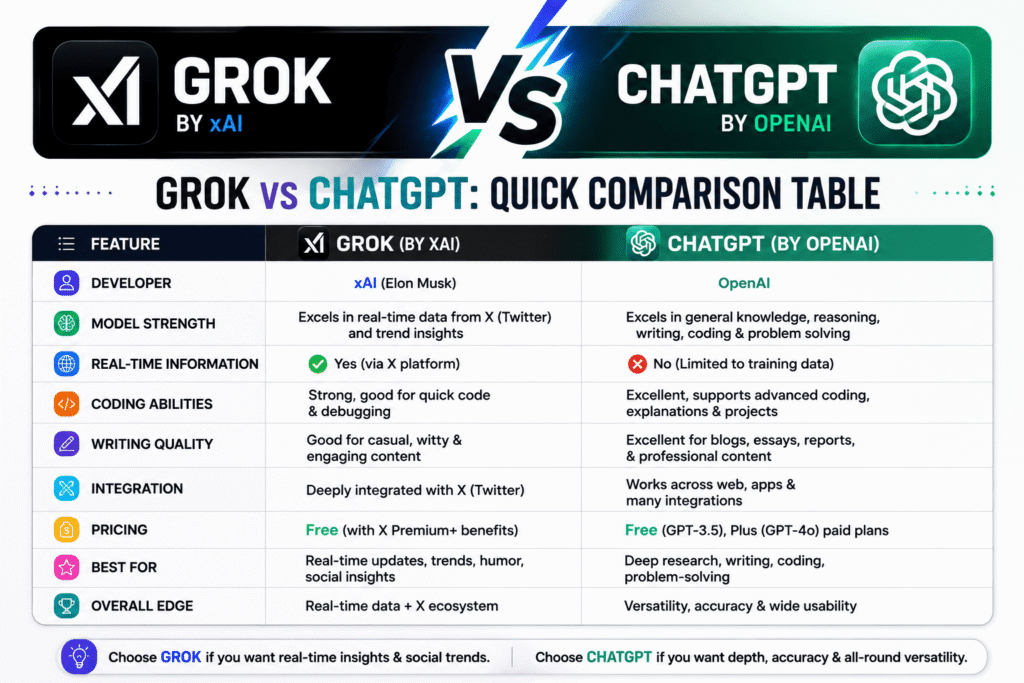
Read →ChatGPT is the better all-around choice for most people — it’s cheaper at the entry tier, has a far larger ecosystem of integrations, and remains the default for coding, writing, and enterprise work. Grok is the better choice if you specifically need real-time information from X, want a larger context window for long conversations, or are doing heavy math/STEM reasoning work. Neither AI has a decisive overall lead in 2026 — the right pick depends on what you’re actually using it for, which is exactly what this guide breaks down.
| Grok (xAI) | ChatGPT (OpenAI) | |
|---|---|---|
| Latest flagship model | Grok 4.5 (July 2026) | GPT-5.6 (July 2026) |
| Free tier | Limited (~10 prompts per 2-hour window via X) | Yes, ad-supported |
| Cheapest paid tier | SuperGrok Lite — $10/mo | ChatGPT Go — $8/mo |
| Most popular paid tier | SuperGrok — $30/mo | ChatGPT Plus — $20/mo |
| Top tier | SuperGrok Heavy — $300/mo | ChatGPT Pro Max — $200/mo |
| Real-time data | Yes, live X integration (its strongest advantage) | Limited, via web browsing |
| Context window | Generally larger (varies by tier) | Smaller, but very consistent across use cases |
| Coding | Strong, improving fast | Historically the stronger coding assistant |
| Ecosystem/integrations | Smaller, growing | 500+ third-party integrations, deep Microsoft 365 ties |
| Enterprise adoption | Still emerging | Used at the large majority of Fortune 500 companies |
Pricing is one of the clearest differences between the two platforms, and it’s shifted a few times through 2026 — here’s where things stand:
ChatGPT (OpenAI):
Grok (xAI):
The takeaway: ChatGPT is cheaper at every comparable rung — Plus at $20 vs. SuperGrok at $30 is roughly a 50% premium for Grok at the standard tier. Grok’s higher tiers lean into raw compute (parallel agent execution, extended reasoning) rather than matching ChatGPT’s broader day-to-day toolkit dollar-for-dollar.
“Smarter” depends heavily on the task. On coding benchmarks, Grok’s newer models have started closing the gap and, on some tests, pulling ahead in raw score while using noticeably fewer tokens per task — a real efficiency advantage if you’re running high volumes of automated tasks. ChatGPT has generally maintained an edge in accuracy and consistency for everyday coding and writing work, along with a more mature toolset (Canvas, Codex) built around those tasks.
For math and STEM-heavy reasoning, Grok has been the stronger performer in independent testing through much of 2026, partly credited to xAI’s approach of using fewer guardrail system prompts and a self-correcting multi-agent architecture. For general knowledge, multimodal understanding (images, documents, video), and polished, production-ready output, ChatGPT tends to edge ahead.
Bottom line: neither model is simply “smarter” across the board. If your work is code- or writing-heavy, ChatGPT will likely feel stronger. If it’s math-, data-, or real-time-research-heavy, Grok is worth having on hand.
This is the single most differentiated feature between the two. Grok’s DeepSearch and live X integration let it pull in real-time posts, trends, and discussion happening on X as part of its answers — something ChatGPT can only approximate through general web browsing, with a real lag behind what’s happening right now.
If your work involves tracking breaking news, social sentiment, or fast-moving public conversations, this is a genuine and largely irreplaceable advantage. If you don’t use X professionally, this advantage matters far less in daily use than the marketing around it suggests — it’s a specific-use-case win, not a general-intelligence one.
The tradeoff: Grok’s real-time features are tied to X’s own uptime. When X has experienced outages, Grok’s live features have gone down with it — a dependency ChatGPT simply doesn’t have.
ChatGPT has been the default AI assistant since 2022, and that head start shows in its ecosystem: 500+ third-party integrations, a mature plugin/app marketplace, and deep ties into Microsoft 365 and Copilot. For businesses already standardized on Microsoft tools, that integration depth is a real, practical advantage — not just a nice-to-have.
ChatGPT is also used across the large majority of Fortune 500 companies as of 2026, giving it far more enterprise polish: team workspaces, admin controls, compliance features, and a track record businesses can point to. Grok is growing quickly in market share, but it’s still building out this side of the platform.
One thing worth being upfront about before you commit to a paid Grok tier: in May 2026, xAI cut image and video generation limits for paying SuperGrok subscribers by a significant margin without advance notice — a sharp, unannounced change that understandably frustrated paying users. xAI has since indicated it would raise limits back up, but the episode is a useful reminder that terms on a fast-moving platform like Grok can change quickly, even for subscribers already paying for a specific feature set.
ChatGPT hasn’t had a comparable incident at this scale, which is part of why it’s generally seen as the steadier, more predictable option for teams that need consistency over time — a meaningful factor if you’re building a workflow or business process around either tool, not just chatting casually.
If you’re also weighing Grok vs ChatGPT vs Gemini, Gemini’s biggest calling card is its very large context window, which makes it a strong fit for working through long documents, large codebases, or multi-file analysis in a single pass — an area where it currently leads both Grok and ChatGPT. Claude, meanwhile, tends to be the strongest pick for long-form writing, careful reasoning, and coding work that benefits from a more deliberate, methodical approach. None of the four major assistants — Grok, ChatGPT, Gemini, or Claude — has a clean, universal lead; the differences are mostly about which strengths match your actual workflow.
If you’re here for the fun version of this question — there isn’t a single winner, and there likely won’t be one anytime soon. Both platforms are advancing quickly and pushing each other to improve faster and price more competitively, which is genuinely good news for anyone using either one. The realistic “best strategy” for power users in 2026 is keeping access to both and routing different tasks to whichever model handles that specific type of work better — real-time research to Grok, polished writing and coding to ChatGPT.
Which is better in 2026, Grok or ChatGPT?
Neither has a decisive overall lead. ChatGPT is generally better for coding, writing, ecosystem integrations, and enterprise use. Grok is generally better for real-time information from X, math/STEM reasoning, and larger context windows.
Is Grok smarter than ChatGPT?
It depends on the task. Grok has performed strongly on math and STEM benchmarks and some coding tests with greater token efficiency, while ChatGPT tends to lead on general accuracy, multimodal tasks, and production-ready output quality.
Is ChatGPT or Grok cheaper?
ChatGPT is cheaper at every comparable tier — ChatGPT Plus is $20/month versus SuperGrok at $30/month, and ChatGPT also offers a lower-cost $8 Go tier and a free ad-supported tier.
Does Grok have real-time data that ChatGPT doesn’t?
Yes. Grok’s DeepSearch and live X integration give it access to real-time posts and trends, which ChatGPT can only approximate through slower general web browsing.
Is Grok reliable for business use?
Grok’s capabilities have improved quickly, but xAI has made unannounced changes to paid-subscriber limits in the past (notably cutting image/video generation limits in May 2026), which is worth factoring in if reliability and predictable terms matter for your use case.
Grok vs ChatGPT vs Gemini — which is best?
It depends on the task: Gemini currently leads on context window size for long documents, ChatGPT leads on ecosystem and coding maturity, and Grok leads on real-time data and math reasoning. None has a universal advantage across every use case.
A note on this comparison: AI model releases, pricing, and feature sets change quickly — this guide reflects publicly available information as of August 2026. Always check each provider’s official pricing page for current rates before subscribing.

You do not need a camera. You do not need a studio. You do not need to show…
Read →Two tools. Both edit video with AI. Both have millions of users who swear by them. And yet…
Read →There is a reason millions of people use both of these tools every single day. They are not…
Read →